
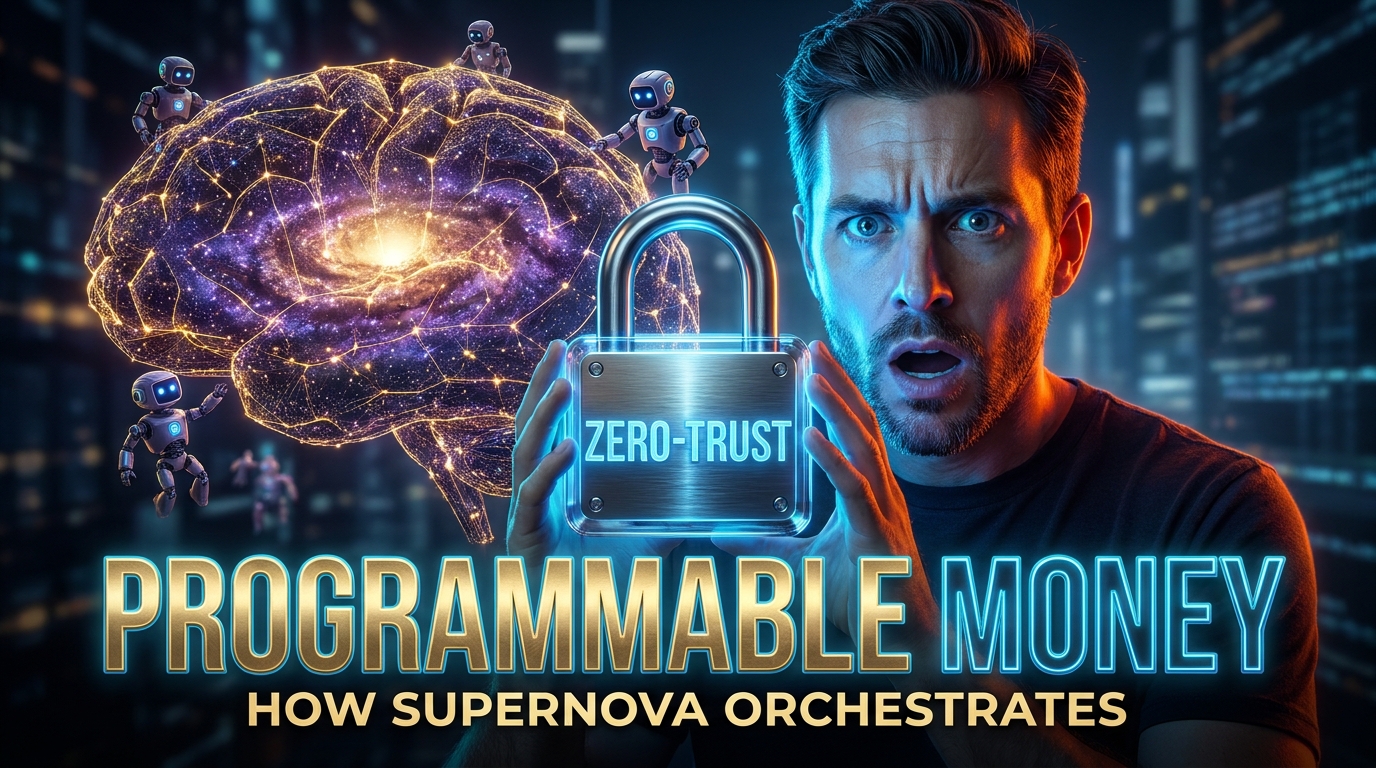
The Paradigm Shift: Autonomous Multi-Agent Systems in Programmable Finance
The global financial system is rapidly transforming into an autonomous, algorithmic web where value is not merely stored or transferred, but programmatically controlled by software. The confluence of smart contract infrastructure, tokenized assets, central bank digital currencies (CBDCs), and distributed machine intelligence has established programmable money as the primary rails for modern financial exchange. Within this decentralized ecosystem, human operators are stepping back from direct transactional execution, yielding operational control to autonomous agents—software entities engineered to perceive market states, evaluate dynamic risk vectors, formulate execution strategies, and settle transactions at sub-second latency.
While this programmatic autonomy yields unprecedented capital efficiency, continuous automated market-making, and algorithmic arbitrage capabilities, it dramatically expands the systemic attack surface. Traditional perimeter security models, constructed around static enterprise firewalls, centralized identity providers, and static access control lists, are completely ineffective in multi-agent, on-chain execution topologies. In a decentralized environment composed of composable smart contracts and external data feeds, physical or network perimeters do not exist. To preserve systemic integrity, mitigate systemic risk, and maintain liquidity solvency, financial architectures require an uncompromising security standard: continuous Zero-Trust orchestration.
Supernova has engineered the pioneering orchestration protocol built explicitly to enforce Zero-Trust principles across decentralized financial infrastructure. By treating every autonomous agent, smart contract interaction, transaction payload, and data oracle as fundamentally untrusted, Supernova establishes the foundational security substrate necessary to power institutional-grade programmable money.
The Threat Landscape: Why Programmable Capital Demands Extreme Security
In traditional centralized banking, fraudulent transfers, unintended execution paths, and ledger errors can be conditionally rolled back through legal intervention, manual database manipulation, or clearinghouse reconciliation. Conversely, programmable money built on distributed ledgers is deterministic, globally composable, and practically irreversible once finality is achieved. An exploit targeting an autonomous liquidity-provisioning agent or an algorithmic treasury protocol results in immediate, permanent capital dissipation.
Several architectural vectors expose autonomous agents to existential threats in algorithmic financial networks:
- Adversarial Prompt Injection and Logic Hijacking: Modern agents powered by large language models (LLMs) or complex reinforcement learning pipelines can be manipulated via untrusted external inputs. Adversaries can inject adversarial prompts via transaction metadata, decentralized governance proposals, or poisoned on-chain text fields, compelling the agent to misallocate capital, surrender administrative privileges, or liquidate vaults under catastrophic conditions.
- Oracle Corruption and Algorithmic Exploits: Agents rely on decentralized price feeds and real-time off-chain data to compute trade sizing, rebalance liquidity, and monitor collateralization ratios. Flash-loan attacks, low-liquidity spot-market manipulation, and latency exploitation can feed corrupted data to autonomous agents, inducing non-deterministic execution states and forcing under-collateralized liquidations.
- Autonomous Credential Leakage: Conventional automated bots often rely on hardcoded private keys or long-lived API secrets stored in environment files or hot memory. Once an exploit penetrates the host server or container environment, the agent's signing capability is completely compromised, granting the attacker carte blanche access to the underlying protocol treasuries.
- Unchecked Composable Cascades: Because decentralized protocols are hyper-composable, an algorithmic failure or security breach in one autonomous lending protocol can trigger an instantaneous chain reaction across interdependent liquidity pools, resulting in a systemic solvency crisis before any human intervention can occur.
Mitigating these complex failure modes requires an architecture that discards ambient authority, assumes active compromise at all times, and validates every operational interaction cryptographically.
The Core Axioms of Supernova's Zero-Trust Orchestration
Zero-Trust security is fundamentally encapsulated by the doctrine of never trust, always verify. While this design pattern has matured within enterprise cloud security, Supernova translates and expands these operational axioms to meet the rigorous constraints of programmable assets, decentralized agents, and asynchronous blockchain environments.
1. Explicit and Cryptographic Agent Verification
Under Supernova, ambient trust does not exist. An agent cannot simply assert its programmatic authority through possession of an isolated API key or static address. Instead, every agent is issued an immutable Decentralized Identifier (DID) tethered to cryptographically verifiable credentials. Before an agent can query an environmental state, execute a mathematical swap routine, or broadcast an on-chain transaction, it must dynamically prove its identity, software state integrity, and execution environment via zero-knowledge remote attestation.
Test Agent Primitive
See the concepts from this article in action. No login required.
2. Principle of Least-Privilege Execution (PoLE)
Supernova eliminates persistent, broad-spectrum permissions. In traditional deployments, automated bots are often granted infinite approvals on ERC-20 smart contracts to streamline execution and avoid recurring authorization overhead. Supernova strictly prohibits this vulnerability. Agent authorizations are granular, time-bound, and dynamically scoped to the discrete task at hand. Utilizing ephemeral session tokens and programmatic proxy architectures, Supernova ensures that even if an agent's runtime environment is compromised, the adversary's lateral access is rigorously constrained to a strictly defined, near-zero balance limit.
3. Continuous Behavioral Anomaly Telemetry
Static rule engines are incapable of keeping pace with the dynamic complexities of multi-agent financial ecosystems. Supernova integrates real-time behavioral telemetry that analyzes agent activity against deterministic algorithmic baselines. The orchestration engine continuously evaluates transaction frequency, slippage deviations, gas expenditure profiles, liquidity consumption velocities, and counterparty smart contract interactions. When an agent's operational parameters drift beyond mathematically tolerated thresholds, the orchestration engine automatically invokes adaptive defensive counter-measures.
Technological Architecture: The Supernova Zero-Trust Stack
Supernova realizes Zero-Trust orchestration through a modular, layered technological stack designed for maximum interoperability, negligible operational latency, and ironclad cryptographic isolation. The table below outlines how Supernova alters traditional operational paradigms across core security dimensions.
| Security Dimension | Perimeter / Legacy Model | Standard Smart Contract Systems | Supernova Zero-Trust Protocol |
|---|---|---|---|
| Identity & Provenance | Static credentials, passwords, IP whitelists | Single private key, unprotected hot wallets | Decentralized Identifiers (DIDs), verifiable cryptographic credentials, hardware enclave attestation |
| Access & Authorization | Persistent ambient trust, role-based access control (RBAC) | Infinite token approvals, unchecked contract privileges | Ephemeral session capabilities, least-privilege scoping, dynamic micro-authorizations |
| Transaction Execution | Centralized batch processing, scheduled cron jobs | Autonomous script execution without contextual safety rails | Multi-Party Computation (MPC), dynamic multi-sig thresholds, zero-knowledge verification |
| Anomaly & Threat Response | Post-incident manual log inspection and firewalls | Post-exploit protocol pauses requiring governance votes | Sub-second automated circuit breakers, behavioral anomaly containment, isolated kill-switches |
| Data Integrity & Ingestion | Centralized endpoints, unprotected APIs | Standard decentralized oracles without behavioral checks | Multi-source attested aggregation, zk-authenticated data pipelines, drift validation |
Cryptographic Key Management via Threshold Multi-Party Computation
To eliminate the single-point-of-failure inherent in traditional private key infrastructures, Supernova integrates distributed Multi-Party Computation (MPC) utilizing threshold signature schemes (TSS). An individual autonomous agent does not possess the complete, unencrypted private key required to execute high-value transactions. Instead, cryptographic key shares are distributed across heterogeneous, isolated nodes within the Supernova Orchestration Network.
When an agent identifies an execution opportunity, it generates a cryptographically signed transaction intent. The transaction payload must be validated against real-time consensus policies—verifying that market conditions, risk metrics, and protocol allocations adhere strictly to deterministic boundary conditions. Only when the consensus thresholds are achieved do the distributed MPC nodes compute their partial signatures, assembling the final on-chain transaction without ever assembling the underlying private key in a single memory space. This completely mitigates the threat of localized runtime key extraction.
Deterministic Execution Enclaves and Sandboxing
Supernova isolates agent decision-making inside Confidential Computing environments, utilizing Trusted Execution Environments (TEEs) such as Intel SGX and AMD SEV. These hardware-enforced, encrypted enclaves protect the agent's internal reasoning logic, risk scoring algorithms, and temporary memory registers from external host compromise, malicious cloud operators, and co-located hostile workloads. Remote cryptographic attestation guarantees that the software running within the enclave has not been tampered with, injected with malicious payloads, or modified post-audit.
Programmatic Circuit Breakers and Dynamic Quarantine
In highly composable decentralized networks, attacks execute in a single block transaction bundle. Consequently, security enforcement cannot wait for human oversight or slow decentralized governance cycles. Supernova incorporates algorithmic, block-level circuit breakers directly into the orchestration fabric.
If an agent attempts an execution that would drain liquidity beyond pre-programmed volatility boundaries, interact with an unverified or newly deployed smart contract, or deviate from historical gas profiling, the transaction is intercepted before broadcast. The orchestration protocol initiates an immediate, stateful quarantine of the suspect agent, revoking its active ephemeral credentials and triggering automated risk dispersal pathways. The rest of the agentic financial swarm continues normal operations without exposing systemic liquidity to contagion.
Regulatory Harmonization: Aligning Autonomous Agents with Global Directives
As programmable money converges with institutional finance, decentralized autonomous agent frameworks must reconcile with emerging international regulatory structures. Far from being an ideological impediment to decentralization, robust Zero-Trust orchestration is the sole mechanism through which autonomous algorithmic systems can achieve institutional legitimacy and regulatory compliance.
Supernova's architectural framework proactively integrates compliance primitives designed to satisfy the world's most rigorous technology governance standards:
- EU Artificial Intelligence Act (Regulation 2024/1689): Article 15 of the EU AI Act explicitly mandates that high-risk autonomous AI systems must be designed and developed with appropriate levels of accuracy, robustness, and cybersecurity. Systems must be resilient against errors, faults, and adversarial attacks (such as data poisoning and adversarial prompts), featuring technical redundancies and failsafe mechanisms. Supernova's TEE-enforced sandboxing, MPC consensus, and behavioral telemetry directly fulfill these statutory mandates.
- Digital Operational Resilience Act (DORA - Regulation 2022/2554): Mandating comprehensive ICT risk management for financial entities operating within the European Union, DORA requires continuous monitoring, anomaly detection, business continuity, and comprehensive security testing. Supernova ensures that autonomous financial microservices remain continuously observable, resilient to external network degradation, and subject to real-time risk controls.
- Cryptographic Auditing and Algorithmic Explainability: To meet strict fiduciary compliance and anti-money laundering (AML) directives, Supernova produces tamper-evident, append-only cryptographic audit trails for every agentic action. By utilizing zero-knowledge proofs (ZKPs), the orchestration platform can mathematically prove that an agent adhered strictly to anti-wash-trading rules, sanction screenings, and capital adequacy requirements without revealing proprietary trading strategies or private alpha parameters to the public ledger.
The Road Ahead: Securing the Machine Economy
We are witnessing the nascent stages of an autonomous economic paradigm where autonomous agents will soon negotiate, barter, deploy capital, and settle complex transactions with other autonomous entities at computational scale. In this hyper-automated future, traditional human-centric legal contracts and perimeter access mechanisms are obsolete. Code, cryptography, and orchestration protocols are the operational infrastructure of trust.
The integrity of programmable money depends entirely on the resilience of the security models that orchestrate its algorithmic custodians. If autonomous agents are left unguarded, deployed over fragile keys, and permitted unfettered systemic access, the programmable financial ecosystem will remain vulnerable to systemic exploits, institutional skepticism, and catastrophic systemic contagion.
Supernova establishes the definitive benchmark for securing this transformative landscape. By operationalizing uncompromising Zero-Trust security—continuous verification, hardware-enforced isolation, distributed threshold execution, and proactive behavioral telemetry—Supernova empowers autonomous agents to execute complex financial logic safely, bridging the gap between decentralized machine autonomy and institutional-grade financial security.
Ready to Build?
Stop guessing. Start building. Every new account gets $5.00 free developer balance (1,000 test calls) instantly upon login to test tools and connect via MCP.
Claim $5 Free Balance →


