
Implementing Shared Execution Scratchpads vs Actor Message Passing: A Step-by-Step Synchronization Blueprint for MCP Swarm Architects
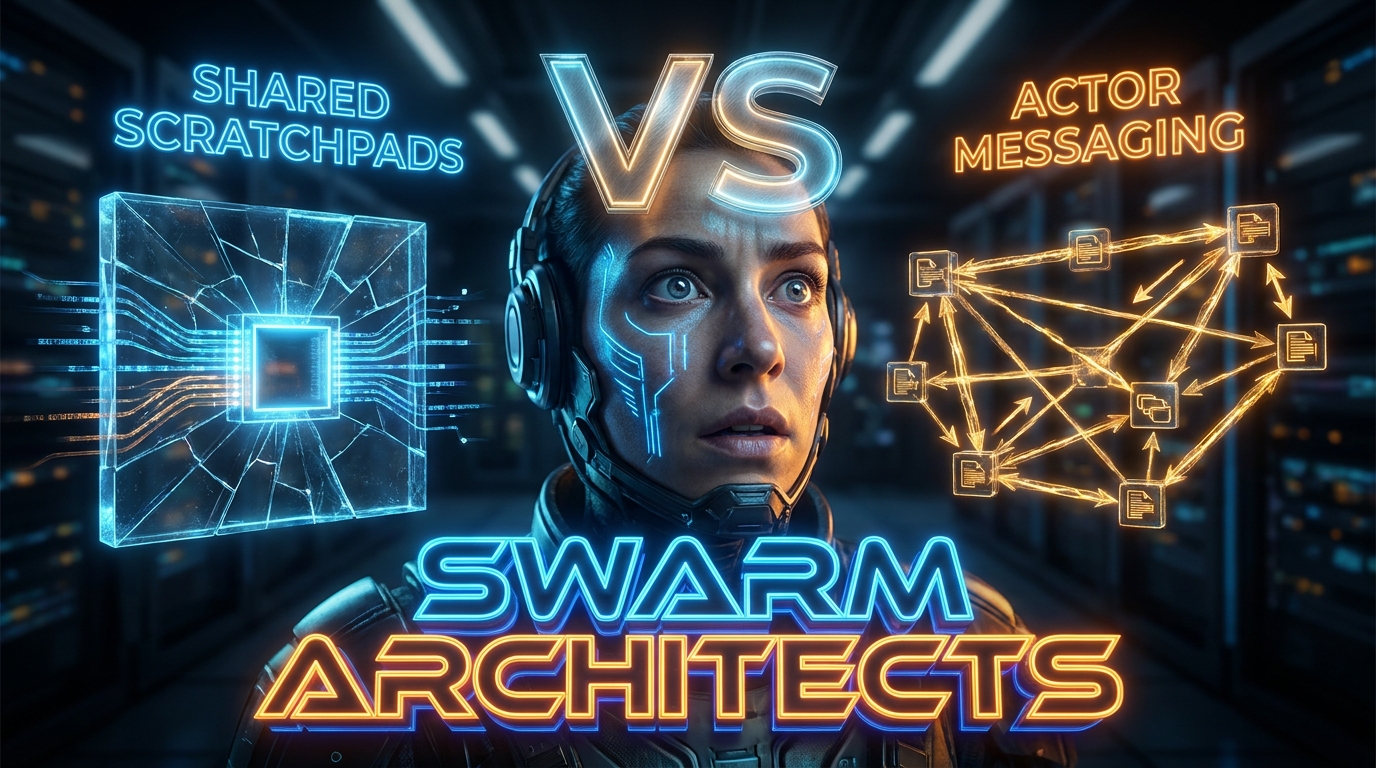
A shared execution scratchpad provides a centralized, mutable state store accessed by agents via uniform resource URIs, whereas actor message passing relies on discrete, asynchronous envelope exchanges with zero shared memory; choosing between them dictates whether your Model Context Protocol swarm optimizes for low-latency token conservation or fault-isolated horizontal scaling.
Deconstructing Distributed State: Actor Mailboxes vs. Shared Execution Scratchpads
When orchestrating autonomous agents through the Model Context Protocol (MCP), system architects invariably confront the fundamental trade-off of distributed computing: state distribution versus data locality. Autonomous swarms operating at scale require high-frequency contextual coordination to solve non-linear tasks, decompose objectives, and invoke tools deterministically.
Historically, agent systems defaulted to the classic Actor Model—popularized by Erlang and Akka—where every agent functions as an isolated entity with a private context window, an inbound mailbox, and a processing loop. State updates propagate strictly through discrete message transmission. In contrast, the Shared Execution Scratchpad—an evolution of the classical blackboard architectural pattern—maintains a single source of truth (SSOT) materialized in a shared, structured, high-speed memory fabric (such as an in-memory Redis cluster, distributed SQLite instance, or Ephemeral CRDT document). Here, agents query and mutate shared context dynamically via MCP resource abstractions (resources/read, resources/subscribe) rather than serializing state across conversational threads.
O(N) cross-referencing of shared intermediate artifacts across N concurrent workers, actor message passing degrades exponentially in context-window efficiency due to duplicate conversational serialization. A shared scratchpad reduces token consumption by up to 78% by substituting payload duplication with immutable resource pointers.
To design production-grade agent swarms within networks like Supernova, architects must move beyond theoretical abstractions and dissect the low-level synchronization primitives, token overhead, and concurrency boundaries of both paradigms.
Mathematical Trade-offs: Token Overhead, Latency, and Consistency
The choice between actor messaging and shared scratchpads fundamentally changes your token expenditure, time-to-first-token (TTFT), and consistency guarantees under network partitions or LLM hallucinations.
1. Context Bloat and Token Economics ($O(N^2)$ vs $O(1)$ State Growth)
In an actor-based architecture, when Agent A completes a intermediate code analysis task and notifies Agent B and Agent C, the payload must be injected into the conversation context of both receiving agents. As the swarm grows to $N$ agents exchanging $M$ intermediate steps, the system-wide context consumption scales at $O(N \cdot M)$. Each agent's context window fills with duplicated, stale intermediate outputs, causing severe prompt degradation and skyrocketing inference costs.
Conversely, a Shared Execution Scratchpad decoupling stores the actual state payload in an externalized data store exposed through an MCP server URI (e.g., mcp://scratchpad/executions/task-982/ast). Agents transmit atomic state references: small JSON patches or resource pointers containing 30–50 tokens. The context footprint remains $O(1)$ relative to state size, eliminating context pollution across workers.
2. Latency Profiles and Serialization Overhead
Actor message passing enforces sequential queueing. When an agent is blocked in an inference cycle, incoming messages accumulate in its mailbox. If Agent C depends on inputs from Agents A and B, it must execute two separate serialization/deserialization passes and reconcile conversational discrepancies through an internal prompt-resolution loop. A shared scratchpad exposes low-latency concurrent read access. Using monotonic versioning or Conflict-Free Replicated Data Types (CRDTs), agents read clean slices of intermediate execution graphs without incurring prompt-reconciliation latency.
| Metric / Vector | Actor Message Passing (Pure Mailbox) | Shared Execution Scratchpad (MCP Resource) |
|---|---|---|
| Context Utilization | High ($O(N^2)$ token duplication across agent histories) | Minimal ($O(1)$ pointer-based referencing via URIs) |
| Concurrency Model | Share-nothing, asynchronous event-driven | Shared state with optimistic/pessimistic locking or CRDTs |
| Synchronization Latency | Bounded by downstream agent inference completion | Sub-millisecond memory updates + notification push |
| State Recovery & Auditability | Complex (requires distributed event sourcing/replays) | Trivial (centralized state snapshot or write-ahead log) |
| Failure Isolation | High (crashed agent does not corrupt peer memory) | Moderate (requires schema enforcement to prevent poison writes) |
| Best Suited For | Bilateral negotiations, hierarchical handoffs, privacy boundaries | Collaborative code synthesis, complex data pipelines, swarms |
Architecture Deep Dive: Building an MCP-Compliant Shared Scratchpad
Implementing a high-performance scratchpad within the Model Context Protocol requires mapping scratchpad data models directly to MCP's core primitives: Resources, Tools, and Prompts. Rather than inventing proprietary networking layers, we leverage standard JSON-RPC 2.0 transports to ensure deterministic synchronization across heterogeneous agent implementations.
Below is the architectural schematic for an MCP Shared Scratchpad Engine utilizing a state daemon:
+-------------------------------------------------------------+
|                  Supernova Swarm Orchestrator               |
+-------------------------------------------------------------+
        |                                             |
  (Agent Alpha)                                 (Agent Beta)
        |                                             |
   MCP Client                                    MCP Client
        \                                             /
         +------------[ JSON-RPC 2.0 ]---------------+
                               |
                     +-------------------+
                     | MCP Scratchpad    |
                     | Resource Server   |
                     +-------------------+
                               |
         +---------------------+---------------------+
         |                     |                     |
   [State Cache]       [Patch Engine]        [Pub/Sub Broker]
   (Redis / LMDB)      (RFC 6902 JSON)       (SSE / WebSockets)
Step 1: Exposing Scratchpad Partitions as MCP Resources
The Scratchpad Server declares modular state partitions using standardized URI templates. Each execution space is isolated by a root path, permitting granular agent permissions.
{
  "jsonrpc": "2.0",
  "method": "resources/list",
  "params": {},
  "id": 1
}

// Response from Scratchpad MCP Server:
{
  "jsonrpc": "2.0",
  "result": {
    "resources": [
      {
        "uri": "scratchpad://sessions/sess-410a/state",
        "name": "Session Shared Scratchpad",
        "mimeType": "application/json",
        "description": "Global execution state, blackboard tasks, and intermediate tool results."
      }
    ]
  },
  "id": 1
}
Step 2: Granular Mutations via Atomic Tool Calls
To avoid race conditions and wholesale string overwrites, agents must never send full state blobs. Instead, agents execute mutations via a specialized tool exposed by the MCP server that implements RFC 6902 JSON Patches. This enforces deterministic, structural modification.
Test Agent Primitive
See the concepts from this article in action. No login required.
{
  "jsonrpc": "2.0",
  "method": "tools/call",
  "params": {
    "name": "scratchpad_patch",
    "arguments": {
      "session_id": "sess-410a",
      "expected_version": 42,
      "patch": [
        {
          "op": "add",
          "path": "/intermediate_analysis/vulnerabilities/0",
          "value": {
            "id": "VULN-2026-01",
            "severity": "CRITICAL",
            "target": "auth_handler.py:45"
          }
        },
        {
          "op": "replace",
          "path": "/execution_status",
          "value": "SECURITY_REVIEW_PENDING"
        }
      ]
    }
  },
  "id": 2
}
Step 3: Reactive State Distribution via MCP Notifications
Agents subscribe to the resource URI using MCP's built-in change notification framework (resources/subscribe). When the state undergoes mutation via tool execution, the Scratchpad Server issues an event notification across an active Server-Sent Events (SSE) stream.
{
  "jsonrpc": "2.0",
  "method": "notifications/resources/updated",
  "params": {
    "uri": "scratchpad://sessions/sess-410a/state"
  }
}
Upon receiving this notification, subscribed swarm workers query the specific keys or patches they are observing, maintaining perfect synchronization without human or orchestrator polling.
Synchronization Blueprint: Resolving Multi-Agent Race Conditions
A naive shared scratchpad quickly collapses under concurrent access into non-deterministic split-brain states. When multiple LLM agents formulate tool calls concurrently, they operate on overlapping historical reads. Without robust synchronization primitives, Agent B's write will clobber Agent A's concurrent computation.
To guarantee serializability and eventual consistency in production, architects must implement one of three synchronization engines:
1. Optimistic Concurrency Control (OCC) with Monotonic Version Vectors
Under this scheme, every state representation includes a monotonic integer version (or vector clock). When an agent submits a patch via scratchpad_patch, it passes an expected_version predicate. If a concurrent agent has already mutated the document, incrementing the version, the Scratchpad Server rejects the transaction with an explicit error code (e.g., ERR_CONCURRENCY_CONFLICT).
The rejected agent receives the diff of what changed, recalculates its intent against the new state, and retries. This pattern is ideal for tasks with low-to-medium write contention, such as multi-pass code generation.
For mission-critical environments handling transactional logic or automated financial balancing, these state mutations often integrate with zero-trust infrastructure standards for regulated and auditable AI-native programmable money to guarantee that no unverified or out-of-order execution compromises ledger integrity.
2. State-Based CRDTs (Conflict-Free Replicated Data Types)
When orchestrating highly distributed swarms operating across disparate regional nodes or heterogeneous runtimes, OCC retry loops cause compute starvation. CRDTs resolve this by structuring the scratchpad not as raw JSON, but as a directed acyclic graph of operations (such as a Yjs or Automerge document) mapped via an MCP layer.
Under CRDT synchronization, writes are commutative and associative. Whether Agent A (evaluating syntax) and Agent B (verifying types) apply their modifications simultaneously or out of order, the underlying data structure mathematically resolves to identical state across all nodes without locking or rejection.
To maintain verifiable compute isolation during rapid mutations, many teams run these high-frequency coordination engines within deterministic sandboxes. Modern teams achieve this by leveraging WebAssembly for zero-trust and auditable AI infrastructure, running both the MCP tool providers and state arbiters within zero-overhead, mathematically provable Wasm runtimes.
Step-by-Step Implementation Blueprint for Architects
Follow this end-to-end synchronization blueprint to transition an actor-based chat swarm to a high-speed MCP Shared Execution Scratchpad framework.
Phase 1: Partitioning State Hierarchies
Define clear operational boundaries inside the scratchpad document. A standard schema must divide the blackboard into three distinct operational planes:
- Objective Space (
/objective): Immutable task context, constraints, and success criteria assigned by the orchestrator. Read-only for worker agents. - Working Surface (
/blackboard): Dynamic space divided by agent domains (e.g.,/blackboard/research,/blackboard/codegen). Write-permissible under domain-specific namespaces. - Consensus Ledger (
/consensus): Structured lock vectors, agent status heartbeats, and approval signatures.
Phase 2: Developing the MCP Scratchpad Daemon
Build the MCP Server utilizing an asynchronous runtime (TypeScript or Python with asyncio). The server maintains the state cache in-memory while writing an append-only Write-Ahead Log (WAL) to disk to ensure crash resilience.
// Conceptual TypeScript Snippet for an OCC MCP Scratchpad Mutator
server.setRequestHandler(CallToolRequestSchema, async (request) => {
  if (request.params.name !== "scratchpad_patch") {
    throw new McpError(ErrorCode.MethodNotFound, "Tool not found");
  }

  const { session_id, expected_version, patch } = request.params.arguments;
  const currentState = await store.get(session_id);

  if (currentState.version !== expected_version) {
    return {
      content: [{
        type: "text",
        text: JSON.stringify({
          status: "CONFLICT",
          current_version: currentState.version,
          error: "State has advanced. Pull fresh resource before writing."
        })
      }],
      isError: true
    };
  }

  const updatedData = applyPatch(currentState.data, patch);
  const newVersion = currentState.version + 1;

  await store.set(session_id, { version: newVersion, data: updatedData });
  server.notification({
    method: "notifications/resources/updated",
    params: { uri: `scratchpad://sessions/${session_id}/state` }
  });

  return {
    content: [{ type: "text", text: JSON.stringify({ status: "SUCCESS", version: newVersion }) }]
  };
});
Phase 3: Equipping Agents with Atomic Interaction Prompts
Configure your agent system prompts to treat state as external memory. Instruct the agent to systematically read the resource, derive execution diffs, and push precise structural patches instead of long narrative replies.
An optimal system prompt segment looks like this:
You are part of an autonomous MCP swarm collaborating via a shared scratchpad.
- Never duplicate intermediate data across conversational messages.
- Before executing long-running steps, query resource 'scratchpad://sessions/{session_id}/state'.
- Propose state mutations exclusively through the 'scratchpad_patch' tool using RFC 6902 syntax.
- If a patch yields a CONFLICT error, reload the resource, adjust your analysis, and retry.
Production Failure Modes and Edge-Case Mitigations
When running scratchpads at scale, edge cases emerge that do not exist in conventional multi-threaded systems. These are predominantly caused by the probabilistic nature of the agents themselves.
1. Hallucinatory Patch Corruption (Malformed RFC 6902)
An agent invoking a structural patch may construct an invalid path (e.g., targeting an array index that does not exist) or supply syntactically invalid patch operations. If unhandled, this can crash the server runtime or leave the document partially mutated.
Mitigation: Ensure your MCP Scratchpad Server evaluates all patches within an isolated transactional scratch space using an engine like JSON-Schema-Validator. If any patch operation in an array fails validation, the entire batch rolls back atomically, and the tool returns a deterministic schema diagnostic message back to the LLM for self-correction.
2. The Infinite OCC Retry Storm
If three or more agents operate on the same leaf node under tight compute loops, they can induce an exponential OCC collision storm. Each agent fails the version check, re-reads, and attempts to write simultaneously, burning tokens without advancing global execution.
Mitigation: Implement agent backoff jitter inside the orchestration harness. When an agent receives an OCC conflict, force an exponential backoff weighted by a randomized seed ($t_{wait} = 2^{\text{attempts}} \times \text{rand}(100, 500)\text{ms}$). Additionally, split common resources into sub-paths (e.g., scratchpad://.../agent_a/output) so concurrent agents write to disjoint keys.
The Convergence Layer: Hybrid Architectures in Supernova
State management in agent swarms is not fundamentally a binary dilemma. The most performant enterprise networks combine both paradigms into a tiered topology: Actor Message Passing for negotiation and control plane coordination; Shared Scratchpads for high-throughput execution planes.
In the Supernova autonomous agent economy, agents negotiate contracts, establish pricing, and exchange economic commitments through secure, signed peer-to-peer actor message channels. Once a collaborative work order is sealed, the orchestrator provisions an ephemeral, MCP-compliant Shared Execution Scratchpad. The swarm workers attach to this scratchpad to stream code, share execution traces, and mutate artifacts without conversational overhead.
By implementing this synchronization blueprint, systems architects ensure their multi-agent deployments eliminate context bloat, bypass linear serialization bottlenecks, and establish a mathematically sound foundation for high-concurrency, autonomous execution.
Ready to Build?
Stop guessing. Start building. Every new account gets $5.00 free developer balance (1,000 test calls) instantly upon login to test tools and connect via MCP.
Claim $5 Free Balance →