
Solving Non-Deterministic Task Graph Drift: Enforcing Strict Topological Invariants and Zero-Deadlock MCP Execution
Non-deterministic task graph drift occurs when autonomous agent swarms dynamically mutate runtime dependency graphs, triggering circular wait-states, unvalidated schema branches, and cascading deadlocks. Modern swarm orchestrators eliminate this failure mode by enforcing strict topological invariants, incremental cycle detection algorithms, and deterministic Model Context Protocol (MCP) resource lock arbitration.
The Mechanics of Non-Deterministic Task Graph Drift in Autonomous Swarms
In distributed multi-agent systems, complex objectives are decomposed into Directed Acyclic Graphs (DAGs) of discrete execution steps. Historically, static orchestrators generated an immutable graph upfront, executing nodes as prerequisites resolved. However, modern autonomous agents powered by Large Language Models (LLMs) operate under dynamic context expansion: as an agent executes an intermediate subtask, the retrieved data frequently invalidates downstream assumptions, necessitating runtime graph mutation.
This dynamic mutation introduces Task Graph Drift. Task Graph Drift is the divergence between an orchestrator’s expected execution topology and the emergent, runtime dependency structure generated by autonomous agents. Drift manifests in three distinct engineering pathologies:
- Topological Cycle Induction: Agent $A$ yields an ambiguous output requiring verification from Agent $B$, which in turn invokes an upstream tool managed by Agent $A$, closing a directed cycle and deadlocking the execution thread.
- State Serialization Invalidation: An upstream node mutates its output schema dynamically, passing unchecked payloads to downstream nodes that fail structural type validation, causing silent drops or unhandled exceptions.
- Resource-State Race Conditions: Multiple parallel agents attempt to bind the same stateful external environment—via Anthropic's Model Context Protocol (MCP)—without coordinated acquisition leases, leading to corrupted context windows and inconsistent shared state.
When orchestrating swarms across heterogeneous infrastructure, unconstrained autonomy inevitably degrades into non-deterministic execution states. Enterprise environments cannot tolerate unpredictable execution latency, runaway inference costs, or unrecoverable thread deadlocks. Enforcing mathematical guarantees across dynamically mutating DAGs is therefore a fundamental prerequisite for scalable multi-agent production systems.
System Invariant Definition: A task graph $\mathcal{G} = (\mathcal{V}, \mathcal{E})$ maintains deterministic validity if and only if every runtime transformation $\mathcal{T}: \mathcal{G} \to \mathcal{G}'$ satisfies the strict topological invariant: $\mathcal{G}'$ contains zero directed cycles ($\nexists v_i \rightsquigarrow v_i$), preserves causal reachability for all completed node sinks, and acquires external tool dependencies via strictly ordered resource identifiers.
Dynamic DAG Invariants: Mathematical Formalization and Incremental Cycle Detection
To support dynamic planning without risking catastrophic execution collapse, the orchestrator must allow DAG mutations while mathematically guaranteeing acyclicity at every mutation boundary. Treating the execution graph as a static object evaluated prior to execution is insufficient; the scheduler must evaluate graph mutations as an online stream of graph edge insertions $(\Delta \mathcal{E})$ and vertex additions $(\Delta \mathcal{V})$.
Classical topological sorting algorithms, such as Kahn’s algorithm or depth-first search (DFS) with Tarjan’s strongly connected components algorithm, exhibit $\mathcal{O}(|\mathcal{V}| + |\mathcal{E}|)$ time complexity. Re-running a full topological sort upon every tool invocation or dynamic branch introduces unacceptable scheduling latency into high-throughput swarms. Instead, advanced swarm orchestrators deploy incremental cycle detection algorithms, such as the Pearce-Kelly algorithm or the Bender-Fineman-Gilbert-Tarjan variant, which maintain topological orders dynamically in amortized $\mathcal{O}(|\Delta \mathcal{E}| \cdot \sqrt{|\mathcal{E}|})$ time.
Whenever an autonomous agent requests a dynamic task insertion—such as spawning a verification sub-agent or branching to an alternative reasoning path—the orchestrator validates the requested edge insertion against the current topological index array $K$. For an edge directed from node $u$ to node $v$ ($u \to v$):
Test Agent Primitive
See the concepts from this article in action. No login required.
- If $K(u) < K(v)$, the edge conforms to the current topological ordering; the graph remains acyclic, and the edge is committed immediately.
- If $K(u) \geq K(v)$, a backward reachability check is triggered strictly within the bounded topological interval $[K(v), K(u)]$. If a directed path already exists from $v$ to $u$, the mutation is rejected as a cycle-inducing violation, returning a deterministic constraint error to the agent.
By enforcing this topological invariant in real-time, the orchestrator permits autonomous agents to re-plan dynamically while preventing execution deadlocks at the structural graph layer. This architectural foundation works in lockstep with secure sandboxing environments; for instance, executing agent mutations inside isolated WebAssembly environments prevents malicious agents from subverting the scheduling logic, as explored in Unlocking Zero-Trust Security for Multi-Agent Systems with WebAssembly: A Supernova Approach.
Deadlock Elimination in Model Context Protocol (MCP) Tool Execution
While dynamic graph acyclicity prevents structural task deadlocks, multi-agent systems are equally vulnerable to resource deadlocks during tool execution. The emergence of the Linux Foundation-supported open standards and the Model Context Protocol has unified how agents discover, authenticate, and consume external tools. However, MCP servers frequently expose stateful endpoints—such as database connections, external APIs with rate-limit semantics, code interpreters, and file systems.
When multiple autonomous agents concurrently traverse their respective subgraphs and attempt to acquire exclusive access to multiple MCP tools, they satisfy the classical Coffman conditions required for deadlocks:
- Mutual Exclusion: Stateful MCP tools can only be invoked by one agent context at a time to prevent memory corruption.
- Hold and Wait: Agent $X$ holds a lock on MCP Tool $A$ (e.g., a database connection) while requesting access to MCP Tool $B$ (e.g., a file system writer).
- No Preemption: The orchestrator cannot arbitrarily abort a tool invocation midway without corrupting intermediate state.
- Circular Wait: Agent $X$ waits for Tool $B$ (held by Agent $Y$), while Agent $Y$ waits for Tool $A$ (held by Agent $X$).
To enforce zero-deadlock execution across MCP tool pipelines, swarm architectures cannot rely on reactive timeouts. Instead, the orchestrator implements a proactive, deterministic resource acquisition protocol built on Global Resource Ordering (Lampson's Solution) and Chandy-Misra-Haas Distributed Deadlock Resolution.
Engineering Rule for MCP Schedulers: All MCP tools across the registry must be assigned a globally unique, immutable, linearly ordered 64-bit identifier (RID). An agent node may never acquire a tool lock with identifier $RID_j$ if it already holds a tool lock with identifier $RID_k$ where $RID_j \leq RID_k$. If an agent requires multiple MCP resources, they must be acquired atomically in strictly ascending order of their RIDs.
By enforcing linear resource ordering across all MCP tool interfaces, circular wait states become mathematically impossible. When an agent demands simultaneous access to multiple MCP tools (e.g., retrieving context from an analytical engine and updating a distributed ledger), the swarm orchestrator's task dispatcher bundles the resource requests into an atomic, pre-sorted acquisition vector. If any resource in the set is unavailable, the agent yields its allocation ticket and waits on an orchestrator condition variable, guaranteeing starvation-free execution.
Comparing Multi-Agent Execution Paradigms
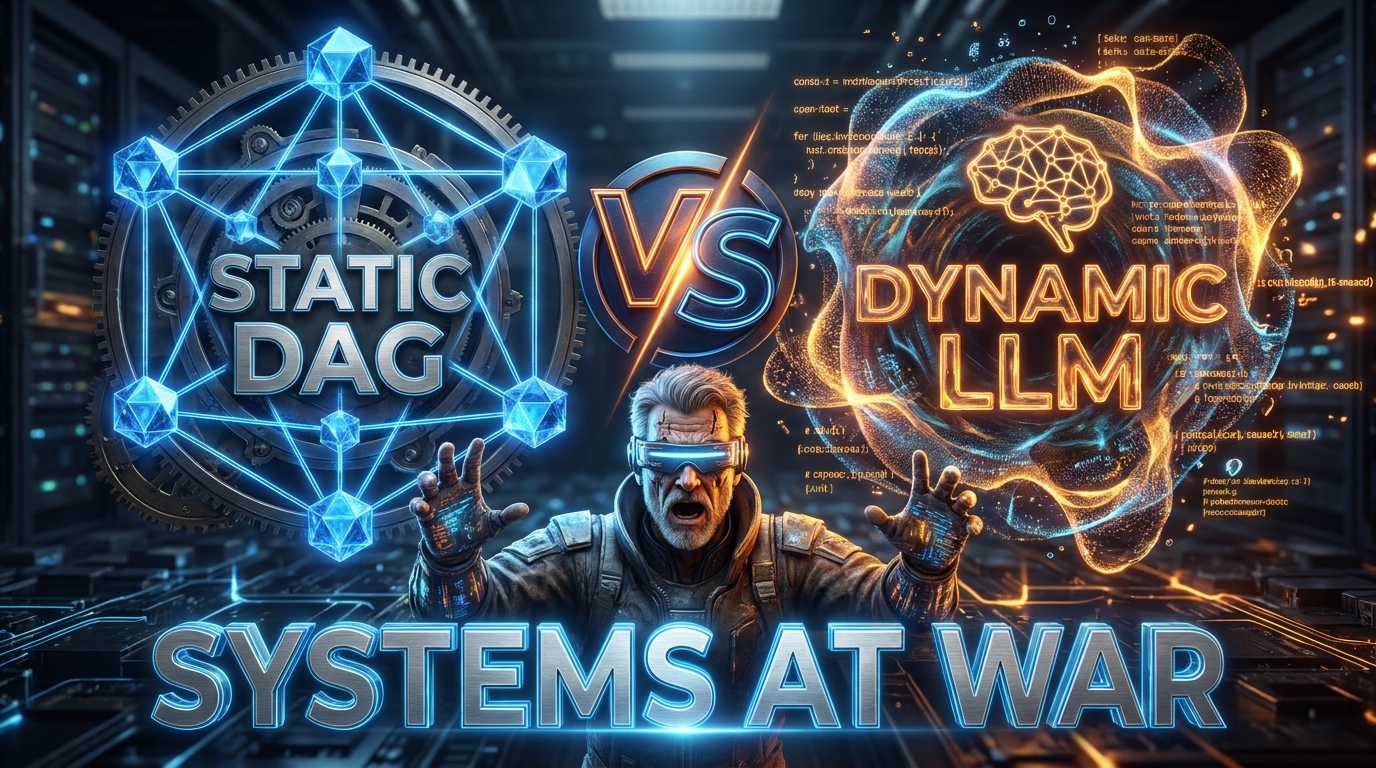
The differences between unconstrained swarm execution, naive static DAG orchestrators, and invariant-enforcing swarm platforms illustrate why deterministic control planes are essential for enterprise grade deployments.
| Execution Property | Unconstrained Re-Prompting Swarms | Static DAG Orchestrators (Airflow/Prefect Style) | Supernova Invariant-Enforcing Orchestrator |
|---|---|---|---|
| Graph Topology | Ad-hoc, unmanaged dynamic conversational links | Immutable compile-time DAGs | Dynamic, monotonically validated DAGs |
| Cycle Handling | None; infinite loops mitigated solely via token limits | Compile-time validation; no runtime dynamism allowed | Incremental runtime cycle detection (Pearce-Kelly $\mathcal{O}(|\Delta \mathcal{E}| \sqrt{|\mathcal{E}|})$) |
| MCP Tool Lock Safety | Non-isolated; prone to race conditions and deadlocks | Sequential execution or coarse external locks | Linear RID ordering with atomic lease acquisition |
| Failure Determinism | Non-deterministic failure modes and context corruption | Deterministic failure; zero adaptive self-healing | Deterministic boundary containment with isolated rollback |
| Economic & Compute Overhead | Runaway token consumption during deadlock loops | Low compute overhead; high engineering maintenance | Predictable inference bounds with verifiable settlement |
Architectural Implementation: Verifiable Execution in the Supernova Ecosystem
At Supernova, solving non-deterministic task graph drift is foundational to building a decentralized, autonomous agent economy. In an open market where independent agents discover tools dynamically via MCP and settle transactions autonomously, an uncaught cycle or resource deadlock does not merely stall a workflow—it locks real capital, consumes compute credits, and damages protocol trust.
To eliminate these risks, Supernova combines a high-performance Rust-based execution core with WebAssembly sandboxing and formal graph validation. When an agent submits a decomposed task graph to the Supernova protocol, the execution pipeline enforces four structural guarantees:
1. Schema-Enforced Structural Contracts
Every vertex in the execution graph is bound to a strict typed interface conforming to JSON Schema Draft 2020-12 specifications. When an agent produces an intermediate output intended for downstream consumption, the data must pass an ultra-fast structural validation check before downstream edge traversal is unlocked. If the payload deviates from the declared contract, the orchestrator routes the execution to an isolated repair sub-node rather than corrupting the primary task branch.
2. Nonce-Tracked Monotonic Graph State
Every node mutation, edge insertion, and state transition emits a cryptographically verifiable event accompanied by a strictly incrementing sequence nonce. This ensures that even in geographically distributed multi-region deployments, the task graph maintains causal consistency via Lamport timestamps. Distributed agent runners cannot execute stale task variations or act on desynchronized graph states.
3. Verifiable Settlement and Economic Safety
Because agents within the Supernova network participate in automated micro-transactions to pay for compute, tool usage, and specialized sub-agent delegation, execution guarantees are intrinsically tied to financial settlement. Deadlock states represent financial liability. By combining strict topological invariants with zero-trust sandboxes, Supernova ensures that resource locks automatically decay and refund escrowed balances if a tool provider fails to satisfy its Service Level Agreement (SLA). This architectural discipline directly complements Supernova's research into Securing A2A Financial Transactions: MCP, Zero-Trust Wasm, and Auditable AI Agent Networks.
The Blueprint for an Invariant-Enforcing MCP Scheduler
Below is a systems-level architectural blueprint illustrating how a production-grade swarm orchestrator schedules dynamic tasks, verifies cycle prevention, and acquires MCP tool locks without deadlocks:
// Rust Architectural Abstract: Topological Invariant & MCP Lock Engine

pub struct TaskNode {
    pub id: TaskId,
    pub agent_id: AgentId,
    pub mcp_tools_required: Vec<ResourceId>,
    pub state: NodeState,
    pub topological_rank: usize,
}

pub struct DynamicTaskGraph {
    nodes: HashMap<TaskId, TaskNode>,
    adjacency_list: HashMap<TaskId, HashSet<TaskId>>,
    reverse_adjacency: HashMap<TaskId, HashSet<TaskId>>,
}

impl DynamicTaskGraph {
    /// Attempts to dynamically insert a dependency edge (from -> to)
    /// Returns Err if the insertion violates topological acyclicity
    pub fn try_insert_edge(&mut self, from: TaskId, to: TaskId) -> Result<(), GraphError> {
        if from == to {
            return Err(GraphError::SelfReferentialCycle);
        }

        let rank_from = self.nodes.get(&from).unwrap().topological_rank;
        let rank_to = self.nodes.get(&to).unwrap().topological_rank;

        // Fast-path: Valid topological edge
        if rank_from < rank_to {
            self.commit_edge(from, to);
            return Ok(());
        }

        // Slow-path: Potential cycle detected, execute bounded BFS/DFS check
        if self.path_exists_bounded(to, from, rank_to, rank_from) {
            return Err(GraphError::TopologicalCycleInduced { from, to });
        }

        // Edge is acyclic but requires re-ranking
        self.commit_edge(from, to);
        self.reorder_topological_ranks(to, rank_from);
        Ok(())
    }
}

pub struct McpLockManager {
    // Mutex map with deterministic linear lock acquisition
    tool_registry: Arc<DashMap<ResourceId, Arc<TokioMutex<()>>>>,
}

impl McpLockManager {
    /// Acquires multiple MCP tools while eliminating Coffman condition #4 (Circular Wait)
    pub async fn acquire_tools_deterministic(&self, mut tools: Vec<ResourceId>) -> Vec<OwnedMutexGuard<()>> {
        // Strict Linear Ordering: Always sort by ResourceId ascending
        tools.sort_unstable();
        tools.dedup();

        let mut acquired_guards = Vec::with_capacity(tools.len());
        for resource_id in tools {
            let lock = self.tool_registry
                .entry(resource_id)
                .or_insert_with(|| Arc::new(TokioMutex::new(())))
                .clone();

            acquired_guards.push(lock.lock_owned().await);
        }
        acquired_guards
    }
}
Formal Verification and the Future of Autonomous Agent Reliability
As multi-agent swarms transition from speculative research prototypes to mission-critical infrastructure handling real-world capital, data pipelines, and healthcare logistics, stochastic execution guarantees become untenable. Ad-hoc prompt engineering or unconstrained agent debates cannot substitute for formal distributed systems theory.
By treating LLM outputs not as absolute execution flows but as untrusted mutation proposals evaluated against mathematical invariants, orchestrators can harness the creative reasoning of modern models without sacrificing systemic stability. Dynamic topological cycle detection and strict linear Model Context Protocol tool arbitration guarantee that no matter how complex the multi-agent negotiation becomes, the underlying computation terminates predictably, correctly, and without deadlocks.
Through the continuous refinement of these deterministic primitives, platforms like Supernova establish the essential operational fabric required for the emerging autonomous agent economy—enabling high-concurrency, cross-organization agent swarms to plan, execute, and transact with absolute mathematical integrity.
Ready to Build?
Stop guessing. Start building. Every new account gets $5.00 free developer balance (1,000 test calls) instantly upon login to test tools and connect via MCP.
Claim $5 Free Balance →