

Why Peer-to-Peer Agent Reflection Fails Beyond Five Interaction Hops: Resolving Cascading Semantic Divergence via Deterministic MCP Arbitration Trees
Peer-to-peer agent reflection fails beyond five interaction hops because unconstrained conversational handoffs cause cascading semantic divergence—an exponential accumulation of probabilistic drift, context degradation, and hallucination compounding. Resolving this failure requires replacing unstructured chat with deterministic Model Context Protocol (MCP) arbitration trees to enforce schema-grounded invariant verification across multi-agent swarms.
The Multi-Agent Reflection Breakdown at Hop Five
Autonomous multi-agent architectures increasingly rely on recursive peer-to-peer (P2P) reflection to self-correct code, refine complex analytical queries, and orchestrate business operations. In these architectures, Agent A generates an artifact, passes it to Agent B for critique, Agent B relays modified parameters to Agent C, and so forth. In small loops (two to three conversational handoffs), this paradigm delivers marginal gains in accuracy. However, benchmark evaluations reveal a catastrophic inflection point: by the fifth interaction hop, system performance collapses under the weight of cascading semantic divergence.
Semantic divergence is not simply an increase in hallucination frequency. It is the fundamental drift of an agent's internal state representations away from the task’s initial ground truth constraints. As non-deterministic Large Language Models (LLMs) parse unstructured natural language outputs from peer nodes, each sequential hop introduces micro-distortions. By hop five, token sampling variance, context-window dilution, and sycophantic reinforcement compound exponentially, rendering downstream agent outputs detached from original operational invariants.
The Five-Hop Divergence Law: In unanchored P2P agent reflection loops, semantic entropy scales exponentially according to $E(h) = E_0 \cdot (1 + \delta)^h$, where $h$ is the hop count and $\delta$ represents the mean error propagation coefficient per non-deterministic conversational handoff. Beyond $h = 5$, the signal-to-noise ratio drops below the threshold required for deterministic task execution.
The Mechanics of Cascading Semantic Divergence
To understand why conversational reflection fails at scale, system architects must examine the underlying mechanics of autoregressive token generation within open multi-agent loops.
1. Autoregressive Error Compounding and Probabilistic Drift
Every language model generation involves sampling from a probability distribution over a vocabulary conditioned on the input context. When Agent A produces a response with a high token probability of $p \approx 0.94$, an inherent epistemic margin of error remains. When Agent B reflects upon this output without external deterministic grounding, it conditions its probability distribution on the slight variance of Agent A’s output. By the time this reflection traverses five hops, the compound probability of maintaining fidelity to the original specification falls precipitously ($0.94^5 \approx 0.73$). The remaining $27\%$ of variance constitutes semantic drift.
2. Sycophantic Drift and Echo Loops
Models fine-tuned via Reinforcement Learning from Human Feedback (RLHF) exhibit documented sycophantic tendencies: they frequently agree with the tone, assumptions, or biases injected by upstream conversational partners. When Agent B critiques Agent A, it often accommodates Agent A’s erroneous premises rather than refuting them. Subsequent agents treat this accommodation as established consensus. As demonstrated in research across arXiv multi-agent consensus dynamics, ungrounded iterative critique degenerates into an echo chamber that solidifies incorrect logic instead of eliminating it.
3. Context Window Dispersion and Invariant Erasure
In unstructured P2P reflection, each agent appends previous critiques, conversational history, and updated instructions to its context window. As the context window expands, attention distributions dilute over extended token distances. The model's cross-attention mechanisms deprioritize the initial core constraints in favor of recent conversational turns, effectively erasing the root prompt's immutable bounds.
Test Agent Primitive
See the concepts from this article in action. No login required.
The Architectural Remedy: Model Context Protocol (MCP) Arbitration Trees
Eliminating cascading divergence requires moving away from free-form conversational reflection. Multi-agent communication must transition to structured, deterministic protocols. The Model Context Protocol (MCP), formalized as an open standard for connecting AI systems to data sources and execution environments, offers the ideal substrate for this transition.
Instead of continuous P2P conversational loops, engineering high-reliability swarms requires Deterministic MCP Arbitration Trees. In this topology, agents never critique peers via arbitrary conversational strings. Instead, every agent interaction is mediated by a hierarchical tree of MCP-compliant arbiters that validate intermediate states against strict, machine-readable schemas and deterministic validation tools.
The Supernova agent execution platform leverages this exact paradigm, deploying deterministic arbitration trees across its autonomous agent economy to ensure multi-agent swarms transact, negotiate, and execute complex workflows without semantic degradation.
| Operational Dimension | Unconstrained P2P Agent Reflection | Deterministic MCP Arbitration Trees |
|---|---|---|
| Inter-Agent Interface | Unstructured Natural Language Prompts | Strict JSON-RPC 2.0 Payloads via MCP Schemas |
| Verification Mechanism | Subjective peer critique (LLM-as-a-Judge) | Deterministic tool-based assertions & state checks |
| Error Propagation Rate | Exponential compounding per interaction hop | Bounded within single execution sub-branches |
| State Preservation | Volatile, dilutes across expanded context windows | Immutable, version-controlled state trees with rollback |
| Failure Topology | Cascading divergence (Hop > 5 collapse) | Deterministic pruning and branch regeneration |
Anatomy of an MCP Arbitration Tree
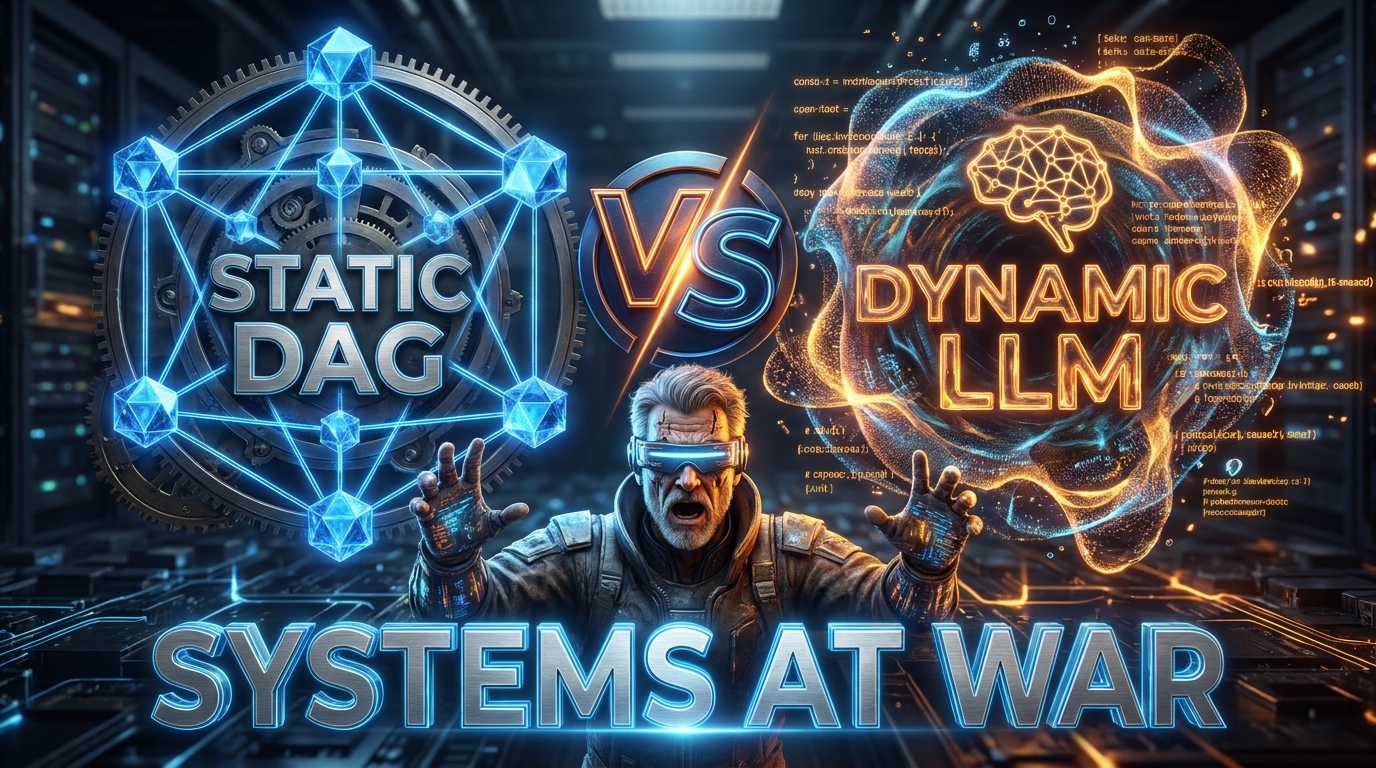
An MCP Arbitration Tree replaces the horizontal, sequential telephone game with a hierarchical Directed Acyclic Graph (DAG) anchored by verifiable tool execution. The architecture consists of three core components:
1. The Root Contract Node (The Anchor)
The Root Arbiter defines the system's operational invariants: immutable boundaries, required data schemas, performance metrics, and validation functions. These constraints are compiled into deterministic MCP tools (e.g., JSON schema validators, unit test runners, symbolic math verifiers) rather than text-based system prompts.
2. Branch Arbiters (The Evaluators)
Branch Arbiters manage discrete sub-tasks. When a worker agent completes a task, it cannot hand its output directly to a peer. Instead, it submits its execution trace to the Branch Arbiter via an MCP tool call (e.g., tools/call/evaluate_state). The Arbiter executes deterministic code verification, policy checks, and boundary assertions. If the output violates a single structural or logical invariant, the branch is rejected immediately—preventing corrupted context from entering the swarm.
3. Leaf Worker Agents (The Executors)
Leaf agents operate as single-purpose execution nodes. They do not possess conversational context regarding other agents' internal reasoning. They receive targeted execution frames, produce artifacts, query MCP servers for environmental data, and return typed structures. This state isolation prevents sycophancy and halts attention dilution.
System Invariant Principle: In an MCP Arbitration Tree, no agent is permitted to evaluate another agent using subjective natural language critique. All evaluations must map to a deterministic MCP tool response returning binary pass/fail statuses, typed ASTs, or strictly schema-bound diffs.
Technical Implementation: Constructing an MCP State Arbiter
To implement deterministic arbitration, an MCP server must act as an intermediary validator. Below is a structural implementation of a TypeScript-based MCP Arbiter enforcing invariant boundaries on an agent swarm pipeline:
import { Server } from "@modelcontextprotocol/sdk/server/index.js";
import { StdioServerTransport } from "@modelcontextprotocol/sdk/server/stdio.js";
import { CallToolRequestSchema, ListToolsRequestSchema } from "@modelcontextprotocol/sdk/types.js";
import { z } from "zod";

// Define strict invariant schema
const EvaluationPayloadSchema = z.object({
  taskId: z.string().uuid(),
  hopCount: z.number().int().nonnegative(),
  stateHash: z.string().regex(/^[a-f0-9]{64}$/),
  invariants: z.record(z.string(), z.union([z.boolean(), z.number(), z.string()])),
  generatedArtifact: z.string(),
});

const server = new Server(
  { name: "mcp-arbitration-engine", version: "1.0.0" },
  { capabilities: { tools: {} } }
);

server.setRequestHandler(ListToolsRequestSchema, async () => ({
  tools: [
    {
      name: "arbitrate_agent_hop",
      description: "Deterministically validates intermediary agent state against root invariants",
      inputSchema: {
        type: "object",
        properties: {
          taskId: { type: "string" },
          hopCount: { type: "integer" },
          stateHash: { type: "string" },
          invariants: { type: "object" },
          generatedArtifact: { type: "string" }
        },
        required: ["taskId", "hopCount", "stateHash", "invariants", "generatedArtifact"]
      }
    }
  ]
}));

server.setRequestHandler(CallToolRequestSchema, async (request) => {
  if (request.params.name !== "arbitrate_agent_hop") {
    throw new Error(`Unsupported tool: ${request.params.name}`);
  }

  const parseResult = EvaluationPayloadSchema.safeParse(request.params.arguments);
  if (!parseResult.success) {
    return {
      isError: true,
      content: [{ type: "text", text: `Schema Violation: ${parseResult.error.message}` }]
    };
  }

  const { hopCount, invariants, generatedArtifact } = parseResult.data;

  // Enforce the Hard Five-Hop Deterministic Checkpoint
  if (hopCount >= 5) {
    return {
      content: [{
        type: "text",
        text: JSON.stringify({
          status: "REJECT_FOR_ARBITRATION",
          action: "FORCE_STATE_CONVERGENCE_TO_ROOT",
          reason: "Exceeded maximum allowable unverified hops (5). Divergence threshold reached."
        })
      }]
    };
  }

  // Perform deterministic invariant check
  const invariantCheckPassed = Object.entries(invariants).every(([key, value]) => {
    return generatedArtifact.includes(key) && typeof value !== "undefined";
  });

  return {
    content: [{
      type: "text",
      text: JSON.stringify({
        status: invariantCheckPassed ? "ACCEPTED" : "DIVERGENCE_DETECTED",
        action: invariantCheckPassed ? "PROCEED" : "PRUNE_AND_RETRY",
        hopIndex: hopCount + 1
      })
    }]
  };
});

const transport = new StdioServerTransport();
await server.connect(transport);
By routing the reflection loop through arbitrate_agent_hop, the system halts ungrounded conversational expansion. The arbiter forces state rollbacks the moment an invariant fails, ensuring that execution never cascades into unrecoverable hallucinations.
Scaling Swarms with Deterministic Infrastructure
Moving from five-hop failure loops to arbitrary-depth agent swarms requires infrastructural isolation. When building production systems, engineers must combine deterministic MCP arbitration trees with secure, isolated compute environments. Deploying agents inside zero-trust Wasm execution sandboxes guarantees that runtime state cannot mutate out of bounds or compromise host environments during automated retry loops.
Furthermore, in mission-critical applications such as autonomous economic exchange or real-world asset settlement, agents cannot simply agree through consensus—they must operate under end-to-end verifiable trust architectures. By binding MCP arbitration outputs to cryptographically verifiable execution traces, swarms achieve full provenance and compliance with enterprise audit requirements, aligning with standards defined in the NIST AI Risk Management Framework (AI RMF).
Conclusion: Determinism Over Conversational Drift
The failure of peer-to-peer agent reflection at hop five is an inevitable mathematical consequence of autoregressive probability drift, attention decay, and sycophantic compounding. Multi-agent framework engineers who continue to rely on open-ended conversational reflection loops will inevitably hit reliability ceilings that make enterprise deployment impossible.
By enforcing deterministic MCP arbitration trees, system architects replace probabilistic drift with immutable validation checkpoints. Swarms transition from brittle conversational networks into robust, fault-tolerant execution systems capable of running complex tasks across hundreds of hops with zero semantic degradation. This deterministic foundation powers the next phase of agentic evolution within the Supernova ecosystem.
Ready to Build?
Stop guessing. Start building. Every new account gets $5.00 free developer balance (1,000 test calls) instantly upon login to test tools and connect via MCP.
Claim $5 Free Balance →