
Static Topological DAG Scheduling vs. Dynamic LLM Task Decomposition: A Systems Architect Guide to Deterministic Multi-Agent Swarm Execution
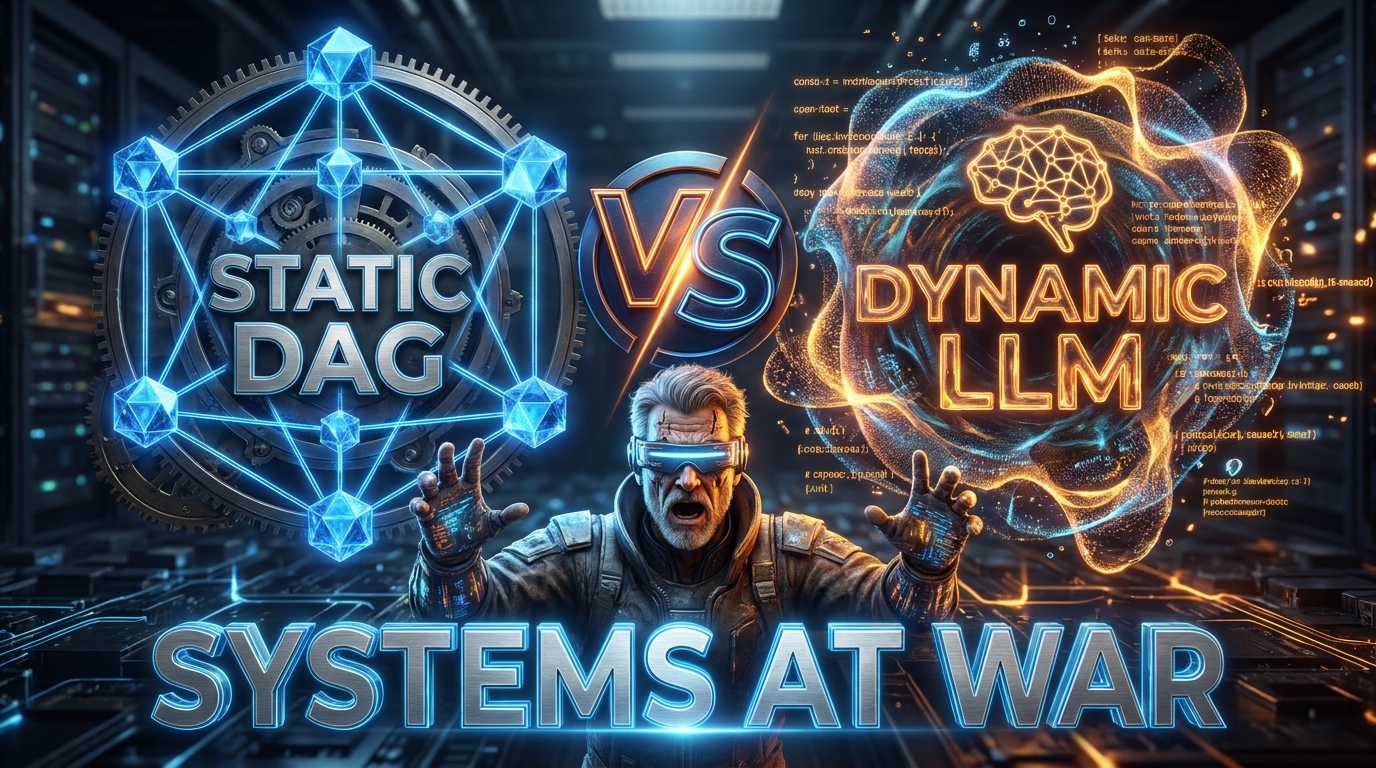
Static topological DAG scheduling compiles agent dependencies into deterministic, compile-time graphs guaranteeing bounded concurrency and invariant execution orders, whereas dynamic LLM task decomposition relies on runtime generative inference to formulate emergent execution sub-graphs, trading strict system determinism and token budget predictability for open-world problem solving and runtime resilience.
As enterprise engineering teams move beyond naive single-agent ReAct loops toward autonomous multi-agent systems, the architectural center of gravity shifts from prompt engineering to distributed systems engineering. When orchestrating heterogeneous agents across asynchronous environments, architects inevitably confront the entropy problem: generative language models are inherently probabilistic, yet enterprise backends, transactional databases, and regulatory compliance frameworks demand strict, reproducible determinism.
This technical guide deconstructs the two foundational execution paradigms for multi-agent swarm orchestration: Static Topological Directed Acyclic Graph (DAG) Scheduling and Dynamic Runtime LLM Task Decomposition. We evaluate the algorithmic primitives, failure domains, state serialization mechanics, and latency characteristics of each approach, concluding with a production blueprint for hybrid, contract-driven architectures utilizing the open Model Context Protocol (MCP) within the Supernova ecosystem.
The Entropy Dilemma in Multi-Agent Swarms
Enterprise orchestration architectures differ fundamentally from conversational agents. In an autonomous agent-to-agent economy, agents do not simply generate prose; they mutate external state machines, execute financial settlements, provision infrastructure, and invoke third-party APIs. A failure in an agentic pipeline is not a typographical error—it is an orphaned transaction, a corrupted database state, or a denial-of-wallet exploit caused by circular dependency traps.
The primary source of execution instability in multi-agent swarms is state entropy. When agents are granted unconstrained agency to decompose goals into subtasks, determine downstream dependencies, and dynamically select downstream collaborators, small latent misalignments in tool output schemas or semantic parsing propagate through the execution chain. Left unchecked, dynamic orchestration cascades into divergent execution branches, concurrent write collisions, and runaway token consumption loops.
Conversely, completely eliminating dynamic agent evaluation leaves organizations with traditional workflow engines like Apache Airflow or Temporal—reliable, deterministic systems that lack the autonomous context interpretation and self-healing resilience that justify adopting foundation models in the first place. Resolving this tension requires rigorously analyzing the two competing paradigm primitives.
Static Topological DAG Scheduling: Determinism by Construction
Static DAG scheduling frames multi-agent workflows as a formally defined mathematical graph $G = (V, E)$, where vertices $V$ represent discrete, immutable agent tasks or typed tool invocations, and directed edges $E$ represent strict data dependencies and execution preconditions. In this paradigm, the complete execution topology is generated, validated, and compiled prior to runtime execution.
Mathematical Foundations & Algorithmic Scheduling
Static scheduling relies on topological sorting algorithms—most notably Kahn's Algorithm or depth-first search (DFS) post-order traversals—to establish a linear ordering of vertices compatible with all dependency edges. The computational complexity of computing this schedule is strictly bounded at $\mathcal{O}(|V| + |E|)$.
Algorithm: Kahn-Based Deterministic Task Scheduler
Input: Graph G = (V, E), In-Degree Array in_degree[]
Output: Concurrent Execution Batches

1. Queue Q = []
2. For each v in V:
3.    If in_degree[v] == 0: Enqueue(Q, v)
4. While Q is not empty:
5.    Layer L = PopAll(Q)
6.    ExecuteConcurrent(L) // Bound parallel workers
7.    For each node u in L:
8.       For each edge (u, w) in OutgoingEdges(u):
9.          in_degree[w] = in_degree[w] - 1
10.         If in_degree[w] == 0: Enqueue(Q, w)
Because the graph structure is static, edge-level data schemas are strictly validated via static typing schemas (e.g., JSONSchema, Pydantic, or Protocol Buffers). Downstream nodes receive typed inputs that are mathematically guaranteed to match their parameter expectations, mitigating hallucinations at the input boundary.
Architectural Advantages
- Zero Runtime Planning Overhead: Because the graph topology is resolved at compile time, zero inference tokens or LLM reasoning passes are consumed to schedule work. This eliminates scheduling latency and slashes API overhead.
- Maximal Bounded Concurrency: Independent branches with zero mutual in-degrees execute concurrently up to the exact thread or worker pool limit, preventing thread starvation and race conditions.
- Deterministic Audit Trails and Idempotency: Every node execution path is reproducible. Replays, checkpoint-restart operations, and backward delta-rollback strategies are mathematically well-defined, aligning with requirements outlined in our deep-dive on building auditable, zero-trust financial rails for autonomous AI agent economies.
Systemic Limitations
The primary vulnerability of pure static DAG scheduling is rigidity in the face of partial failures or environmental mutations. If an external API returns an unexpected error code or an unstructured document requires an adaptive extraction loop, the static graph lacks the runtime cognitive capacity to inject corrective intermediate steps. It can retry, fail over to a pre-defined fallback edge, or crash the execution pipeline entirely.
Test Agent Primitive
See the concepts from this article in action. No login required.
Dynamic LLM Task Decomposition: Runtime Cognitive Synthesis
Dynamic LLM task decomposition rejects static topologies. Instead, an orchestrator model or decentralized agent cluster receives an overarching goal state $S_{target}$, evaluates the current environment context $C_{env}$, and dynamically generates an ad-hoc action plan. This paradigm is popularized by cognitive frameworks like Plan-and-Solve, BabyAGI, and emergent swarm architectures utilizing dynamic delegation protocols.
Mechanisms of Emergent Runtime Branching
In a dynamic decomposition paradigm, graph generation is interleaved with execution. An LLM acts as the runtime graph mutator: it observes the output of Task $T_i$, assesses delta progress toward $S_{target}$, and generates zero, one, or multiple downstream task nodes $T_{i+1}, \dots, T_{i+k}$ on the fly.
This dynamic decomposition often interfaces with standardized tool endpoints via protocols like Anthropic's open Model Context Protocol, where tool signatures, system resources, and environment prompts are exposed directly to the model's runtime context window, enabling runtime tool selection and parameter generation.
Architectural Advantages
- Open-World Problem Solving: The swarm handles edge cases, schema variances, and semantic ambiguities that human system architects failed to anticipate at design time.
- Self-Healing Iteration Loops: When a tool invocation fails, the decomposition model inspects the error trace, adapts its context window, and spawns alternative recovery sub-agents (e.g., executing an alternative search query or falling back to local OCR parsing).
- Dynamic Tool Synthesis and Discovery: Through decentralized registries like the Supernova network, agents discover, authenticate with, and invoke new MCP tool servers dynamically as unexpected sub-problems arise.
Systemic Vulnerabilities
Dynamic decomposition shifts architectural complexity directly into runtime failure modes:
- State Space Explosion & Deadlocks: Without formal cycle detection algorithms executed after every generative step, dynamic planners regularly generate cyclic dependencies ($A \to B \to C \to A$), locking orchestrators into infinite resource-draining loops.
- Context Window Degradation: As the dynamic execution history grows, appending intermediate scratchpads, raw tool responses, and reflection loops leads to token context window saturation, severe attention decay, and exponentially escalating inference costs.
- Non-Deterministic Latency Distributions: A task that requires 3 seconds on one run may spawn an unexpected sub-swarm requiring 45 seconds on an identical input, making SLA adherence mathematically impossible.
Comparative Systems Matrix
The architectural trade-offs between static topological scheduling and dynamic task decomposition span resource consumption, safety guarantees, and systems engineering complexity:
| Architectural Dimension | Static Topological DAG Scheduling | Dynamic LLM Task Decomposition | Hybrid Bounded Macro-DAG (Optimal) |
|---|---|---|---|
| Scheduling Overhead | Sub-millisecond ($\mathcal{O}(|V| + |E|)$ deterministic) | High (1.5s - 15s per generative planning loop) | Deterministic routing + localized inference |
| Concurrency Invariants | Strictly bounded by graph topology | Probabilistic; prone to race conditions | Strict layer bounds with isolated sub-graphs |
| Failure Domains | Predictable edge-level error states | Cascading hallucinations, infinite loops | Sandboxed node failures with circuit breakers |
| Token Cost Profile | Deterministic (Input + Task prompt tokens) | Unbounded; stochastic step expansion | Budget-capped sub-graph execution quotas |
| Auditability & Compliance | Full compliance; deterministic replay | Low; non-reproducible graph trajectories | Full macro-auditability with captured micro-logs |
| Tool Integration Surface | Pre-compiled typed schemas | Runtime dynamic discovery via MCP | Verified MCP servers via secure interfaces |
The Production Blueprint: Deterministic Macro-DAGs with Dynamic Micro-Swarm Nodes
Systems architects in enterprise settings do not have to accept an absolute binary choice between fragile rigidity and chaotic non-determinism. Production-grade multi-agent architectures resolve this tension by adopting Hierarchical Bounded Macro-DAGs.
Under this architecture, the mission-critical business workflow is modeled as a strictly typed, immutable static DAG at the macro layer. However, individual compute nodes within this macro-graph are not merely static scripts; they are sandboxed micro-planners configured with strict execution budgets, typed contracts, and localized scope.
Architectural Invariants of the Hybrid Pattern
- Typed Input/Output Contracts at Node Boundaries: The macro-DAG enforces strict input and output validation gates (e.g., using strictly typed schema validators). A dynamic micro-agent inside Node $N_x$ can dynamically decompose its localized objective into internal sub-tasks, but it cannot emit data or trigger downstream macro-edges until its output adheres strictly to the pre-compiled output schema.
- Strict Token and Wall-Clock Circuit Breakers: Every dynamic leaf node is bounded by a hard cap on cumulative token expenditure, execution time, and recursion depth. If an internal dynamic loop fails to converge within its resource budget, the macro-engine terminates the sub-graph and trips a deterministic failure edge.
- Ephemeral Tool Sandboxing via MCP: Micro-agents interact with their environment exclusively through Model Context Protocol (MCP) servers deployed in isolated runtimes. To explore secure execution sandboxes, review our analysis on how standardized AI Model Context Protocols enable zero-trust interoperability for Wasm-powered confidential autonomous agents.
Execution Architecture Flow
[Macro Ingestion Layer]
          │
          ▼
┌───────────────────┐        ┌───────────────────┐
│ Macro Node 1 (DAG)│ ─────► │ Macro Node 2 (DAG)│
│ (Deterministic)   │        │ (Deterministic)   │
└───────────────────┘        └─────────┬─────────┘
                                       │
            ┌──────────────────────────┴──────────────────────────┐
            │ Bounded Dynamic Sub-Graph Engine                    │
            │                                                     │
            │  [Local Planner] ──► (Infers runtime tool needs)    │
            │         │                                           │
            │         ▼                                           │
            │  [MCP Discovery] ──► Query Supernova Registry       │
            │         │                                           │
            │         ▼                                           │
            │  [Sub-Agent Swarm] ──► Tool Call A / Tool Call B    │
            │         │                                           │
            │         ▼                                           │
            │  [Schema Validator Gate] (Contract Assertion)       │
            └──────────────────────────┬──────────────────────────┘
                                       │ (Emits Typed Output)
                                       ▼
                             ┌───────────────────┐
                             │ Macro Node 3 (DAG)│
                             │ (Deterministic)   │
                             └───────────────────┘
This separation of concerns preserves systemic determinism at the orchestration layer while unlocking localized cognitive adaptability where unstructured real-world ambiguity occurs.
State Reconciliation and Fault-Tolerant Execution
In distributed multi-agent systems, failure is not an anomaly—it is an operating reality. When dynamic task execution encounters transient external network drops or persistent logical assertions, naive orchestrators fail catastrophically. Robust enterprise frameworks implement robust state reconciliation mechanisms.
Idempotency Keys and Distributed State Snapshots
Every node invocation across the macro-DAG must carry an immutable, cryptographically verifiable idempotency key derived from:
$$\text{IdempotencyKey} = \mathcal{H}(\text{PipelineExecutionID} \parallel \text{NodeID} \parallel \text{InputPayloadHash})$$
If an agent node crashes mid-execution or trips a network timeout, the orchestrator issues a replay using the exact idempotency key. The execution engine inspects the state store (e.g., distributed append-only logs or Redis-backed state stores), detects previous partial writes, and safely rolls forward without duplicating side effects. This state hygiene is foundational to building resilient networks, as detailed in our guide on governing secure and scalable autonomous AI agent ecosystems.
Poison Pill Handling and Adaptive Fallback Routing
A persistent vulnerability in dynamic swarms is the "poison pill"—a malformed input or edge-case response that repeatedly triggers an unhandled exception or hallucinated loop in an LLM planner. In pure dynamic architectures, the agent exhausts its retries and terminates the entire workflow.
In a hybrid topology, poison pill handling is managed by static graph rules:
- Exponential Backoff with Jitter: Automatic retry policies are applied strictly at the transport and tool execution levels before re-invoking expensive generative planning steps.
- Degraded-State Fallback Edges: If a dynamic micro-planner fails to yield valid schema-compliant output after $k$ attempts, the macro-DAG diverts execution to a static, deterministic fallback node (e.g., logging a structured error, notifying a human-in-the-loop queue, or applying a baseline deterministic heuristic).
Engineering Autonomous Agent Economies with Supernova
As agents scale from internal enterprise automations to decentralized, economic actors that contract, pay, and collaborate across corporate boundaries, manual graph configuration becomes an enterprise bottleneck. The next evolution of swarm infrastructure bridges the gap between programmatic determinism and decentralized market dynamics.
The Supernova platform is designed precisely for this architectural reality. By providing a production-grade substrate for agent-to-agent negotiation, standardized tool exposure via the Model Context Protocol (MCP), and automated escrowed settlement rails, Supernova allows distributed engineering teams to:
- Expose Typed MCP Capabilities: Register tools, data feeds, and specialized compute pipelines into an auditable network where capabilities are indexed by semantic capability and cryptographic signature.
- Enforce Bounded Economic Budgets: Embed hard micro-transactional budgets directly into agent task graphs, ensuring dynamic micro-planners operate within hard programmatic financial ceilings.
- Execute Deterministic Cross-Agent Agreements: Use cryptographically auditable state rails to ensure that dynamic task execution between heterogeneous multi-tenant swarms is verifiable, billable, and deterministically auditable.
Conclusion: Architectural Guidance for AI Systems Engineers
The debate between static topological scheduling and dynamic task decomposition is not a competition where one paradigm renders the other obsolete. It reflects the classic distributed systems challenge of balancing structural guarantees against runtime adaptability.
Architects who build mission-critical enterprise platforms must resist the urge to hand total orchestration authority to generative models. Unbounded dynamic decomposition belongs inside contained execution sandboxes, governed by formal topological invariants, strictly typed interfaces, and hard economic boundaries.
By compiling deterministic macro-DAG structures that leverage sandboxed, MCP-enabled micro-agents, systems engineers capture the true value of autonomous agents: robust cognitive flexibility bounded by mathematical and architectural predictability.
Ready to Build?
Stop guessing. Start building. Every new account gets $5.00 free developer balance (1,000 test calls) instantly upon login to test tools and connect via MCP.
Claim $5 Free Balance →