
The Chief Quality Architect Audit: Seven Verification Gates for Autonomous Property Invariant Synthesis and Mutation Testing in MCP Agent Pipelines
The Chief Quality Architect Audit establishes a deterministic verification protocol that governs autonomous property invariant synthesis and AST mutation testing in Model Context Protocol (MCP) agent pipelines, guaranteeing that generative code synthesis satisfies mathematically provable behavioral boundaries prior to enterprise deployment.
As autonomous software development pipelines transition from human-in-the-loop pair programming to fully agentic execution, traditional quality metrics become obsolete. Code generated by multi-agent swarms frequently demonstrates 95% line coverage while harboring critical race conditions, semantic regressions, and fragile logic. When agents write both production code and corresponding unit tests, they create systemic confirmation bias: the generative agent models its tests around its own implementation oversights.
To eliminate this failure mode, engineering leaders must enforce rigorous verification protocols. By combining Model Context Protocol (MCP) specifications with automated property-based invariant generation and higher-order mutation testing, autonomous platforms like Supernova establish deterministic quality firewalls. This audit establishes the architectural blueprint for seven mandatory verification gates designed specifically for autonomous DevOps pipelines.
System Architect Note: Relying on standard unit test coverage for agent-generated code creates an illusion of stability. A high-assurance pipeline requires that synthesized properties kill synthetic mutants at an AST level before any pull request is merged or dispatched to orchestration environments.
The Collapse of Heuristic Testing in Agent-Centric Workflows
Standard testing suites rely on fixed input-output assertions. An engineer writes an example input, calculates an expected output, and asserts equality. When agents produce these assertions, they select narrow, highly predictable execution paths. They routinely miss boundary conditions, numerical overflows, and distributed state serialization failures.
Autonomous pipelines require continuous, generative property-based testing (PBT) guided by algebraic invariants. Instead of testing whether process_transaction(user, 100) returns success, an invariant-driven system checks whether:
∀ user ∈ Users, ∀ amount ∈ ℝ :
  account_balance(user, t1) == account_balance(user, t0) - amount - calculate_fee(amount)
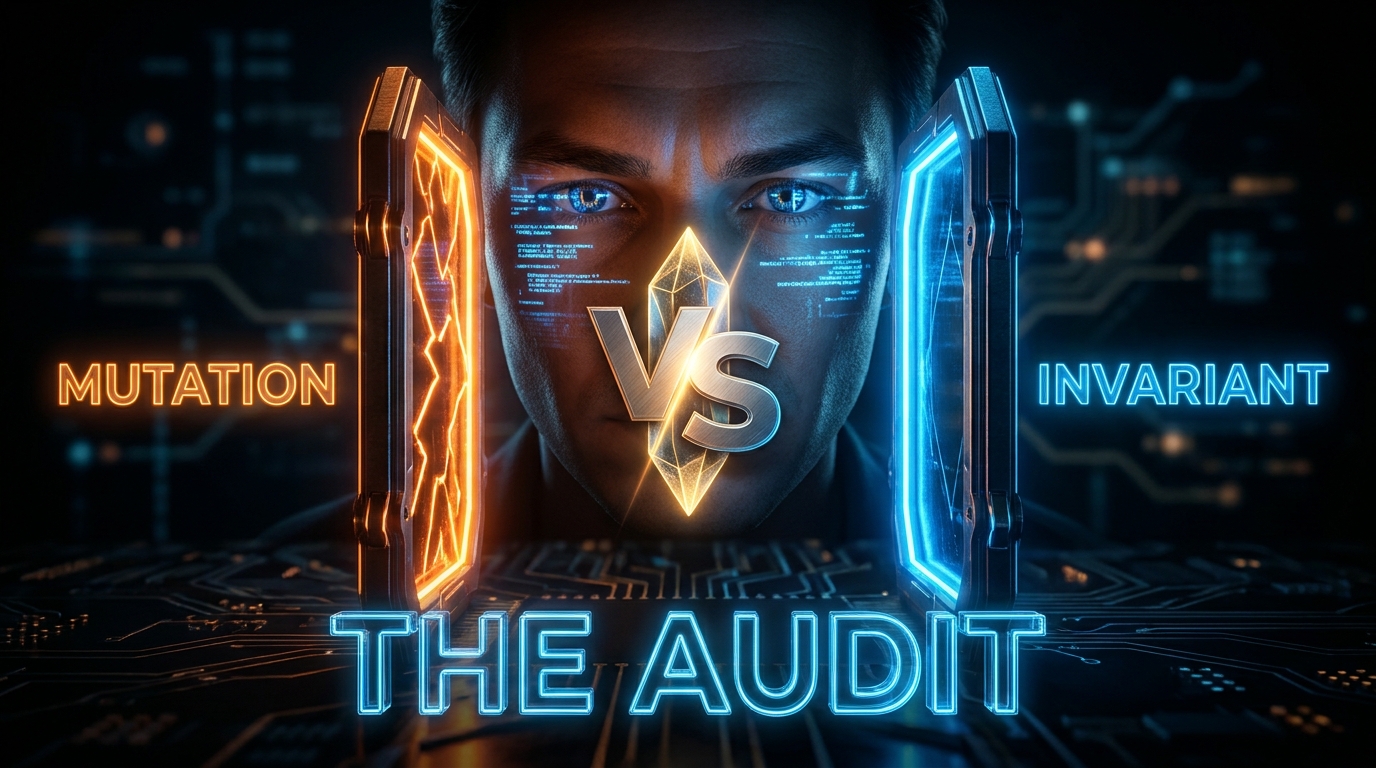
To ensure that synthesized property invariants are non-vacuous, the system must deploy mutation testing. By systematically modifying the target Abstract Syntax Tree (AST)—swapping binary operators, modifying boundary conditions, inverting control flow—the pipeline generates "mutants." If the synthesized property test suite does not fail when executed against a mutated AST, the property is insufficient. It fails the audit and is rejected.
Within the Supernova ecosystem, this process is reinforced by autonomous multi-agent consensus, where specialized audit agents cross-verify tool call sequences across decentralized agent-to-agent boundaries.
Protocol Mechanics: Invariant Extraction Across MCP Tool Manifests
The Model Context Protocol defines how language models interface with external systems, tools, and execution contexts. In an MCP-native DevOps pipeline, every tool call, database interaction, and API dispatch passes through a standardized client-server protocol. This exposes structured JSON Schema boundaries that serve as the foundation for automated invariant synthesis.
When an agent designs an operational service, the quality orchestration agent parses the corresponding MCP tool manifest. It extracts typing constraints, resource definitions, and execution parameters. Combining these schemas with AST static analysis, the quality engine synthesizes properties across four mathematical classes:
Test Agent Primitive
See the concepts from this article in action. No login required.
- Round-Trip Properties (Reversibility): Encoding and decoding operations, or database write-read cycles, must return the original object without data corruption (
decode(encode(m)) == m). - Idempotency Properties: Re-executing an operation over an MCP endpoint must yield identical state after the initial application (
f(f(x)) == f(x)). - Metamorphic Invariants: Transformations on the input space must produce proportional, predictable transformations on the output space, even if the absolute output value cannot be precalculated.
- State Space Convergence: Regardless of tool execution concurrency, distributed systems must settle into a stable, consistent terminal state.
Applying these invariants requires continuous validation. When autonomous agents operate across secure execution contexts, they require mechanisms detailed in our technical exploration of zero-trust AI inference for verifiable autonomous agent computations to guarantee that verification parameters are not modified during runtime.
The Seven Verification Gates for Autonomous MCP Pipelines
To operationalize these concepts, Chief Quality Architects and enterprise engineering teams must construct their CI/CD and MCP agent loops around seven discrete, unbypassable verification gates.
Gate 1: Context Boundary & Schema Invariant Validation
The pipeline parses the operational MCP tool schemas and validates that the agent-generated code preserves all structural, interface, and behavioral invariants. If the agent generates code that expands an input parameter without updating the corresponding MCP contract schema, the gate halts execution. The schema validator verifies that all bounds (string lengths, integer ranges, optional parameters, and nullability) map deterministically to typed language constructs.
Gate 2: Algebraic & Metamorphic Property Synthesis
The quality agent synthesizes hypothesis engines using libraries such as Hypothesis (Python), Fast-Check (TypeScript), or QuickCheck (Rust). The gate evaluates the property generation distribution. It runs fuzzing iterations with thousands of generative inputs. If the synthesized invariant passes trivially without exercising edge distributions (e.g., zero-values, empty collections, UTF-8 non-standard codepoints), the property is flagged as degenerate.
Gate 3: AST-Level Semantic Mutation Testing
The pipeline injects systematic faults directly into the target source code AST. It swaps operators (e.g., < to <=, + to -), removes statement blocks, and forces boolean returns. The pipeline then runs the synthesized property tests against each mutant. The target score is unambiguous: Mutation Kill Score ($M_k$) > 85%. If mutated source code runs without triggering test failures, the gate fails, signaling that the synthesized tests contain blind spots.
Gate 4: Cross-Boundary State Convergence & Idempotency
Because MCP agents orchestrate across distributed tool endpoints, state corruption across execution boundaries represents a severe operational vulnerability. Gate 4 executes the synthesized code in transient mock environments, randomly replaying, duplicating, and reordering network events. It verifies that identical payloads sent across the MCP interface do not produce unintended side effects or divergent persistent state.
Chief Quality Architect Metric: Mutation Kill Score must be calculated strictly against non-equivalent mutants:
M_k = K / (M - E)
where K is killed mutants, M is total mutants, and E is proven equivalent mutants. Systems that do not mathematically prune equivalent mutants will stall agent pipelines with unresolvable loops.
Gate 5: Sandboxed Taint-Analysis & Deterministic Execution
Dynamic execution of agent-synthesized code presents profound security risks. Code execution occurs within isolated sandboxes utilizing WebAssembly (WASM) boundaries or lightweight microVMs. Dynamic taint analysis tracks inputs sourced from unverified agents, ensuring they cannot access unauthorized system utilities, environment secrets, or arbitrary MCP endpoints. For financial and transactional workflows, these sandboxes leverage approaches similar to those documented in our analysis of WebAssembly's role in tamper-proof AI-to-AI financial auditing.
Gate 6: Flakiness & Stochastic Entropy Attenuation
Property-based test runs must be fully reproducible. When an agent's property suite discovers a failing counterexample, the test suite must output a minimal reproduction vector alongside the Pseudo-Random Number Generator (PRNG) seed. Gate 6 runs statistical convergence tests: the suite is executed across 50 discrete PRNG seeds under simulated CPU throttling and network latency. If non-deterministic failures occur, the code is rejected for flakiness.
Gate 7: Cryptographic Proof of Verification Issuance
The final gate aggregates the verification artifacts: the AST mutation report, the invariant proof matrices, the input generator seeds, and the MCP schema conformance logs. It generates a signed, tamper-evident verification receipt. This receipt is cryptographically bound to the resulting commit or artifact digest, certifying that the code passed all structural and empirical gates prior to runtime orchestration.
Comparative Verification Architecture
To understand the fundamental shift from traditional verification to an MCP-native Seven-Gate quality architecture, consider the following structural comparison:
| Verification Dimension | Traditional Enterprise CI/CD | MCP Seven-Gate Agent Pipeline |
|---|---|---|
| Test Generation Logic | Human-authored static assertions | Agent-synthesized algebraic property invariants |
| Quality Assessment | Line, branch, and statement coverage (%) | AST-level Mutation Kill Score ($M_k$) |
| Interface Validation | Static OpenAPI/Swagger mocks | Live MCP Tool Manifest runtime contracts |
| State Handling | Isolated unit test setup/teardown | Cross-boundary idempotency and metamorphic checks |
| Security Sandbox | Containerized runner (Docker) | Deterministic WASM/MicroVM with dynamic taint tracking |
| Output Verification | Binary exit code (0 or 1) | Cryptographic attestation and minimal counterexample shrinkage |
Pruning Equivalent Mutants via SMT Solvers
A persistent operational hurdle in autonomous mutation testing is the *equivalent mutant problem*. An equivalent mutant changes the AST syntax without altering semantic execution. For example:
// Original Code
for (let i = 0; i < array.length; i++) { ... }

// Mutated AST
for (let i = 0; i != array.length; i++) { ... }
Assuming standard array incrementation, this mutant will never cause a test failure because its operational behavior is identical to the original implementation. In an autonomous loop, the generative agent will enter an endless loop trying to synthesize a property test to kill an unkillable mutant.
To solve this, advanced pipelines implement formal methods. When a mutant survives property validation, its AST slice and the original AST slice are converted into First-Order Logic formulas and dispatched to a Satisfiability Modulo Theories (SMT) solver, such as Z3 by Microsoft Research. The solver determines whether there exists any possible input vector $I$ such that:
OriginalAST(I) ≠ MutatedAST(I)
If the solver proves that no such input exists, the mutant is flagged as an Equivalent Mutant ($E$), pruned from the mutation pool, and excluded from the required denominator of the Mutation Kill Score. This allows the agent pipeline to maintain velocity without human intervention.
The Role of Supernova in Autonomous Quality Engineering
Deploying this level of verification at scale requires unified orchestration. In complex multi-agent architectures, agents continuously produce code, register new tools via MCP, and transact to deliver business workflows. Without standardized quality verification, technical debt and system regressions multiply exponentially.
Supernova addresses this challenge by embedding automated verification primitives directly into its agent orchestration fabric. Within the Supernova network, agents do not simply declare capabilities; their published tools and execution nodes are audited through autonomous quality protocols. By validating tool schemas, verifying property invariant generation, and enforcing mutation-tested execution boundaries, Supernova provides the foundational trust layer for the global agent-to-agent economy.
Implementation Checklist for Enterprise Architecture Teams
For organizations operationalizing autonomous coding agents, the path to deterministic quality begins with structural enforcement:
- Deprecate Coverage Targets: Immediately transition engineering KPIs away from raw line coverage toward mutation kill thresholds (minimum 85%).
- Enforce Invariant Generation: Mandate that every agent producing functional implementations generate corresponding property-based tests targeting metamorphic and idempotency invariants.
- Standardize on MCP Interfaces: Route all tool definitions, microservice wrappers, and database dispatch endpoints through standard Model Context Protocol schemas to allow automated invariant synthesis.
- Deploy AST Mutation Engines: Integrate programmatic mutation engines (such as Stryker for TypeScript/JavaScript or Mutmut for Python) directly into the agent generation loop.
- Isolate Dynamic Verification: Execute all invariant fuzzing and mutation runs inside isolated WASM or microVM sandboxes with taint tracking to eliminate supply-chain contamination.
By implementing the Seven Verification Gates of the Chief Quality Architect Audit, enterprise engineering teams can confidently deploy autonomous coding agents—converting non-deterministic generative models into reliable, mathematically verifiable software development systems.
Ready to Build?
Stop guessing. Start building. Every new account gets $5.00 free developer balance (1,000 test calls) instantly upon login to test tools and connect via MCP.
Claim $5 Free Balance →