
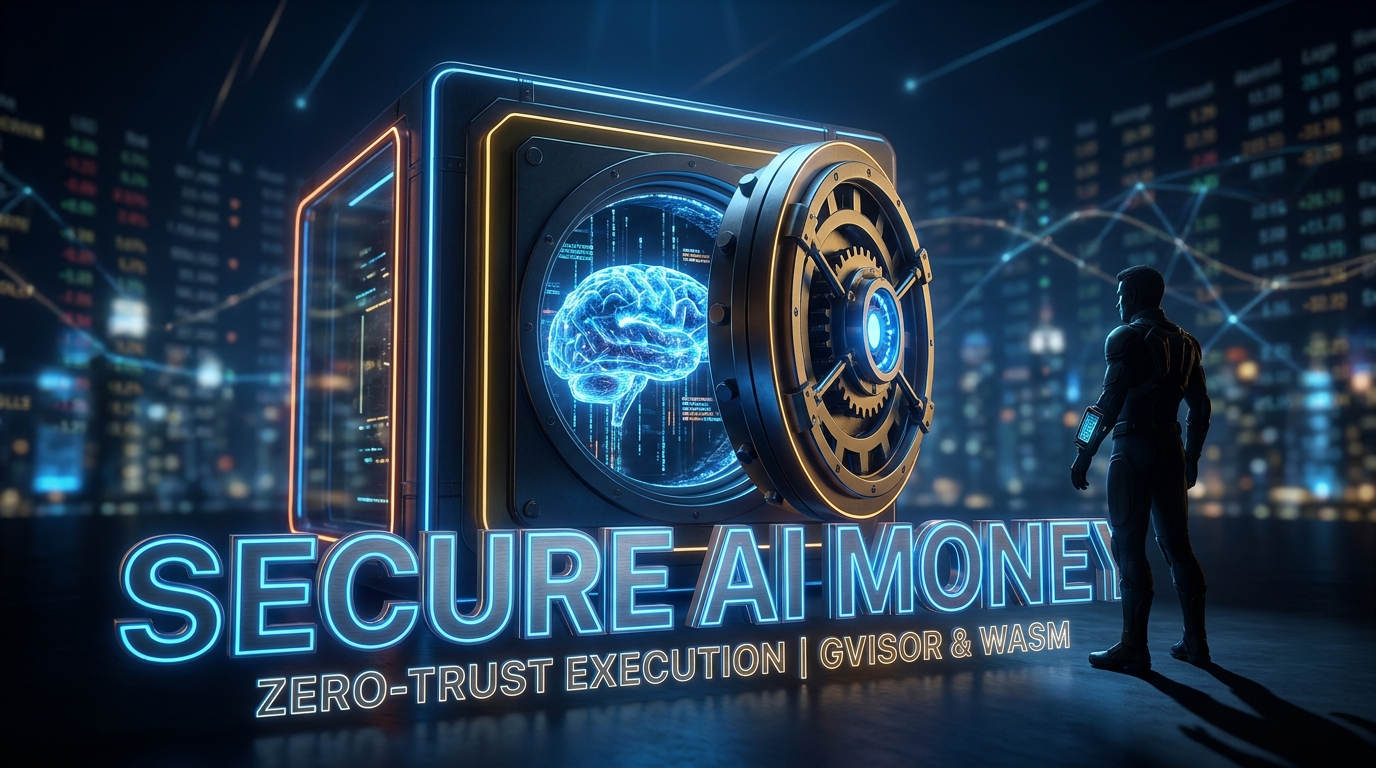
The global financial ecosystem is advancing rapidly toward autonomous machine-to-machine economies. Artificial Intelligence (AI) has transitioned from passive analytical advisory to active, autonomous execution across algorithmic trading, credit adjudication, dynamic liquidity rebalancing, and decentralized finance (DeFi) arbitration. However, the unchecked delegation of capital allocation to autonomous agentic workflows introduces catastrophic threat vectors: systemic market contagion, adversarial prompt injection, model jailbreaking, and severe non-compliance penalties from global regulatory bodies.
For enterprise FinTech architectures, Tier-1 banking institutions, and AI agent framework developers, the core engineering challenge is architectural: How can organizations empower autonomous AI agents to negotiate and execute financial transactions at scale while enforcing mathematical guarantees of security, containment, and auditability? The definitive solution lies in Zero-Trust Execution Environments (ZTEEs) powered by gVisor and WebAssembly (Wasm).
The Critical Anatomy of AI-to-AI Financial Autonomy
AI-to-AI financial autonomy describes distributed computational ecosystems where autonomous models interface with counterparties, execution venues, and decentralized smart contracts without human-in-the-loop dependencies for individual transactions. These workflows operate across four primary high-consequence domains:
- High-Frequency Arbitrage & Market Making: Microsecond-level evaluation of cross-venue order books and predictive execution.
- Autonomous Balance Sheet & Treasury Optimization: Dynamic reallocation of enterprise working capital across collateralized money markets based on real-time liquidity forecasts.
- Automated Dispute Settlement & Parametric Claims: AI agents acting as neutral arbiters verifying claims data, evaluating contractual conditions, and triggering financial settlement.
- Cross-Protocol DeFi Interactions: Autonomous agents managing collateral ratios, yield strategies, and flash loan executions across sovereign blockchain networks.
The operational velocity of these interactions renders traditional human oversight physically impossible. Consequently, security, governance, and compliance policies must be cryptographically baked into the execution boundary itself.
The Regulatory Landscape: Enforcing Non-Negotiable Compliance
Financial authorities worldwide have made it clear that autonomous algorithms will not be granted sovereign immunity from established market regulations. Deploying agentic financial systems requires strict adherence to multi-jurisdictional compliance frameworks:
- EU AI Act (High-Risk Classification): AI systems managing critical financial infrastructure and creditworthiness fall under strict regulatory mandates (Articles 9, 14, and 15), requiring systemic risk management, continuous robustness verification, cybersecurity resilience against adversarial manipulation, and verifiable technical kill-switches.
- EU Digital Operational Resilience Act (DORA): Mandates that financial entities maintain complete control over ICT security risks, requiring strict containment mechanisms to prevent algorithmic errors from propagating through financial networks.
- MiFID II (RTS 6 Requirements): Imposes strict organizational requirements on investment firms engaged in algorithmic trading, including pre-trade risk controls, real-time circuit breakers, and deterministic transaction logging.
- US SEC Rule 15c3-5 & FINRA Regulatory Notices: Mandates systemic pre-trade credit and risk filters that prevent erroneous orders, market manipulation, or unverified automated leverage allocation.
The Vulnerability of Traditional Compute Infrastructures
Historically, enterprise teams have deployed autonomous models inside conventional Linux containers (e.g., Docker, standard Kubernetes runtimes like runc). In financial production systems, this architecture constitutes an unacceptable attack surface:
Standard containers share the underlying host operating system kernel. If an autonomous agent processes adversarial data—such as a prompt injection hidden in a financial memo, a poisoned model weight file, or corrupted market data—a buffer overflow or zero-day vulnerability could allow a complete container breakout. Once the host kernel is compromised, an attacker gains unauthorized access to private signing keys, cross-tenant financial records, and core settlement networks.
Test Agent Primitive
See the concepts from this article in action. No login required.
The Core Engine: gVisor and WebAssembly (Wasm) Architecture
To establish true Zero-Trust Execution for financial AI, modern systems implement a layered isolation strategy pairing gVisor and WebAssembly. Each technology addresses distinct operational profiles within the enterprise AI tech stack.
1. gVisor: User-Space Kernel Isolation for Deep Learning Frameworks
Developed by Google, gVisor is an Open Container Initiative (OCI)-compliant runtime that implements an application kernel in user space. It isolates workloads by interposing a virtualized control layer between the application and the host operating system:
- The Sentry: Acts as the guest kernel, intercepting and handling all application system calls directly in user space, avoiding dangerous direct host syscall passthrough.
- The Gofer: A secure file system proxy that restricts host file access, enforcing strict principle-of-least-privilege boundaries.
gVisor is uniquely suited for hosting complex, dependency-heavy AI agent runtimes—such as PyTorch models, LangChain/LlamaIndex controllers, and Python-based execution engines—preventing malicious or erratic model actions from touching the host infrastructure.
2. WebAssembly (Wasm): Lightweight, Deterministic Sandboxing for Decision Logic
WebAssembly provides an ultra-fast, memory-isolated bytecode standard. When coupled with the WebAssembly System Interface (WASI), Wasm becomes the premier sandboxing technology for financial execution logic:
- Sub-Millisecond Cold Starts: Wasm modules initialize in microseconds, allowing ephemeral sandboxes to spin up per transaction and terminate immediately after execution.
- Linear Memory Isolation: A Wasm module cannot access any host memory outside its strictly allocated sandbox range, eliminating memory corruption vulnerabilities.
- Capability-Based Security: File system, network, and environmental permissions must be explicitly granted at instantiation, preventing unauthorized data exfiltration or unvetted trade orders.
- Deterministic Output: Wasm ensures identical execution traces across disparate hardware environments, an indispensable feature for regulatory trade reconstruction.
Architectural Comparison: Compute Isolation Paradigms
Selecting the appropriate isolation architecture requires balancing operational performance with security guarantees. The following matrix illustrates the performance and compliance trade-offs across common compute paradigms:
| Isolation Dimension | Standard OCI (Docker/runc) | gVisor Sandboxing | WebAssembly (Wasm / WASI) |
|---|---|---|---|
| Kernel Sharing | Direct Host Kernel Sharing (High Risk) | User-Space Virtual Kernel (Zero Direct Syscalls) | Complete Runtime Isolation (No OS Syscalls) |
| Startup Latency | 500ms – 2000ms | 150ms – 400ms | < 5ms (Sub-millisecond possible) |
| Memory Footprint | Moderate to High (100MB+) | Moderate (20MB – 50MB) | Ultra-Lightweight (< 2MB) |
| Isolation Strength | Low (Namespaces/Cgroups only) | High (Syscall Interception via Sentry) | Cryptographic / Linear Memory Hardened |
| Deterministic Execution | No (OS-dependent scheduling) | Moderate (OS-dependent) | Yes (Guaranteed byte-level determinism) |
| Regulatory Suitability | Non-Compliant for Autonomous Capital | Ideal for Complex AI Agent Runtimes | Ideal for Transaction Validation & Auditing |
Cryptographic Attestation, Lineage, and Immutable Auditing
Isolating runtime execution is only the first half of the zero-trust paradigm. The second imperative is establishing a verifiable, tamper-evident audit trail for regulatory scrutiny. A production ZTEE pipeline implements:
- Remote Hardware Attestation: Verifies the cryptographic signature of the underlying hardware and sandbox environment before delegating transaction signing keys to an agent.
- Provable Data Lineage: Every prompt input, intermediate model inference tensor, contextual retrieval document, and final financial API call is signed and recorded in an append-only, tamper-resistant cryptographic ledger.
- Ephemeral Execution lifecycles: Sandboxes are generated on-demand for a single transaction lifecycle and destroyed upon completion, neutralizing persistent threats and lateral movement.
Enterprise Blueprint: Implementing ZTEEs for Scalable Financial AI
Engineering teams looking to deploy compliant autonomous agents should adopt a hybrid architectural blueprint:
Phase 1: Agent Reasoning & Strategy (gVisor Layer)
Deploy large language models (LLMs), agentic orchestration frameworks, and real-time market data ingestion pipelines within gVisor-isolated container runtimes. This maintains compatibility with enterprise Python and C++ AI libraries while securing host systems against zero-day exploits.
Phase 2: Risk Scoring & Trade Generation (Wasm Guardrail Layer)
Route the proposed trade actions generated by the reasoning agent into a high-performance Wasm sandbox. This module executes pre-trade regulatory checks (e.g., maximum drawdown limits, counterparty exposure validations, anti-market manipulation filters) within a strictly deterministic, sandboxed environment.
Phase 3: Cryptographic Settlement & Attestation
Once the Wasm validation engine approves the trade parameters, the transaction payload is signed via an isolated hardware security module (HSM) or Multi-Party Computation (MPC) cluster and submitted to the financial exchange or blockchain settlement layer.
The Path Forward for Enterprise AI Leadership
Financial autonomy driven by autonomous AI agents represents a multi-trillion-dollar efficiency revolution. However, organizations that deploy autonomous models on unhardened, shared-kernel compute architectures expose themselves to severe systemic, financial, and regulatory liabilities. By standardizing on Zero-Trust Execution Environments utilizing gVisor and WebAssembly, enterprise leaders can unlock true computational autonomy—accelerating transaction velocity while maintaining absolute regulatory compliance and impenetrable security boundaries.
Ready to Build?
Stop guessing. Start building. Every new account gets 1,000 NOVA credits instantly upon login to test the registry and route intents.
Claim 1,000 Credits →


